












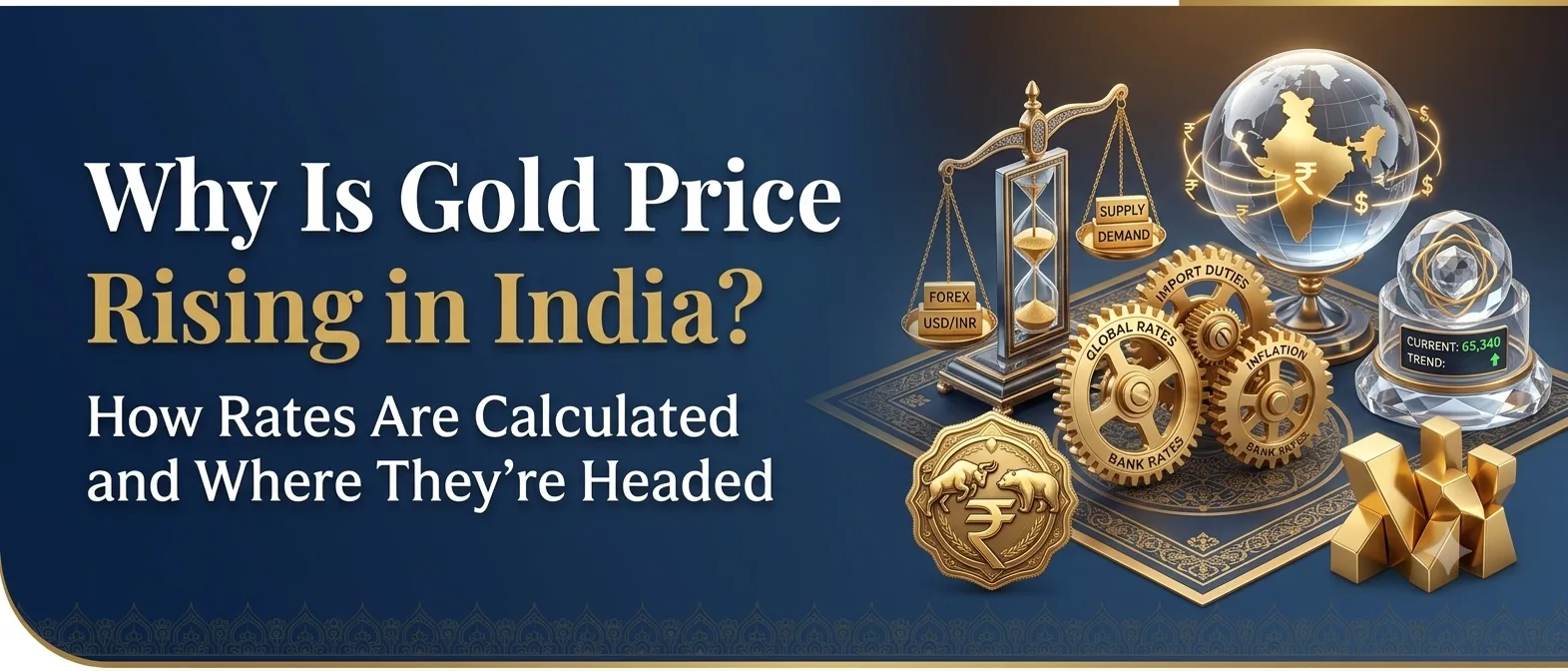






Gold prices in India don't move on a whim. Behind every rupee-per-gram figure you see on a rate page is a chain of international and domestic forces, some that shift by the hour, others that take months to show up.
If you've watched the rate climb over the past year and wondered whether that's a temporary spike or the new normal, or whether it's worth waiting for a dip before buying, this guide walks through how the number is actually built, why it keeps rising, and what history says about the times it hasn't.
What Decides the Gold Price in India Today
The gold price you see quoted for any given day in India isn't set by a single exchange or authority. It's assembled from a few moving parts, and each one updates on its own schedule:
The international gold price, quoted in US dollars per troy ounce on global bullion markets, which resets continuously during trading hours.
The rupee-to-dollar exchange rate, since Indian gold is priced in dollars internationally but sold here in rupees.
Import duty and other government levies, which get added to the landed cost of gold brought into the country.
GST, charged on top of the final jewellery or bullion price.
Local dealer and jeweller margins, which account for the small day-to-day and city-to-city differences you'll notice even within India.
Because of this, "today's gold price" is really a snapshot, a figure recalculated from the previous night's international close, adjusted for the rupee's movement, and passed down through dealers each morning. It's also why rates aren't identical in every city on the same day: transport costs and local associations' pricing conventions add small, genuine variation on top of the national number.
How Is Gold Price Calculated in India?
It helps to see the calculation in order, since each step explains one layer of the final price:
Start with the international spot price in USD/ounce.
Convert to rupees using the day's USD/INR exchange rate.
Convert ounces to grams (1 troy ounce = 31.1 grams) to get a per-gram base rate.
Add import duty, since almost all of India's gold is imported rather than mined domestically.
Add GST, currently applied on the value of gold sold.
Add making charges, if you're buying jewellery rather than bars or coins, this is the only variable the jeweller fully controls, and it's where negotiation room actually exists.
This is also why 24K (999), 22K (916), 20K (833), and 18K (750) rates are never the same number; each reflects a different gold purity, and the price scales down with it. A 750 rate being lower than a 916 rate isn't a bargain; it's simply less gold per gram.
A rough worked example makes this easier to follow: if the international price works out to roughly ₹9,500 per gram for pure (999) gold after currency conversion, import duty might add a few hundred rupees per gram, and GST is applied on top of that combined figure.
What reaches the 22K (916) price tag is that same base figure scaled down to 91.6% purity, before making charges are added separately for jewellery. None of this is arbitrary - each layer is a real cost that was added somewhere between the international market and the shop counter.
Why Are Gold Rates Increasing Day by Day?
If the daily rate has felt like it only moves in one direction lately, there's a reasonable explanation, and it isn't one single cause; it's several trends reinforcing each other at once.
A weaker rupee makes imported gold costlier. Since gold is priced in dollars internationally, every rupee of depreciation against the dollar shows up directly in the local price, even if the international dollar price hasn't moved at all.
Global uncertainty pushes investors toward gold. Gold has historically served as a hedge during periods of inflation, currency volatility, or geopolitical tension, because unlike currencies or equities, it isn't tied to any single government or company's performance. When uncertainty rises globally, demand for gold as a "safe" asset tends to rise with it, and that demand shows up in the international price first.
Central banks have been buying. Several countries' central banks, India's included, have increased their gold reserves in recent years as part of reducing reliance on any single foreign currency for reserves. Large, sustained buying from central banks adds steady upward pressure on the international price, independent of retail jewellery demand.
Domestic demand adds a seasonal layer. India's wedding season and major festivals such as Dhanteras, Akshaya Tritiya, and regional festivals depending on the state bring a predictable spike in jewellery buying each year. This doesn't move the international price, but it can add short-term local premiums and higher making charges during peak weeks.
None of these forces act alone. A weak rupee during a high-demand festival month, for instance, compounds rather than simply adds, which is part of why price increases can feel sharper at certain points in the year than others.
There's also a structural piece worth understanding: India imports the large majority of the gold it consumes, since domestic mining output is small relative to demand. That makes the country's gold price unusually sensitive to two things outside anyone's local control, which include global bullion prices and the rupee's exchange rate, more so than a country that mines a meaningful share of what it uses.
This is part of why Indian gold rates tend to track international and currency trends closely, with domestic demand acting more as an amplifier during specific weeks than as an independent driver of the broader trend.
Will Gold Rate Increase in India? What the Trend Actually Shows
It's worth being direct here: no one, including large financial institutions with research teams dedicated to this exact question, can reliably predict short-term gold prices. What can be said is what the underlying drivers suggest, and where the uncertainty sits.
Over the long term, looking at India's gold price across decades rather than months, the trend has been upward, driven by a combination of global inflation, a gradually depreciating rupee, and growing overall demand. This long-term pattern is part of why gold is often treated as a store of value rather than a short-term trade.
In the shorter term, the rate depends on factors that genuinely can shift in either direction: central bank buying could slow, the rupee could stabilize or strengthen, and global risk sentiment could ease. Any of these would soften the upward pressure, even temporarily.
The honest answer is that the direction over the next few months depends on international monetary policy and currency movements that are genuinely hard to call in advance, which is also true of every other asset class, not unique to gold.
Can Gold Price Go Down in India?
Yes, and it has, more than once. Gold doesn't move in a straight line, even during a broader upward trend. Prices have corrected after central banks have raised interest rates aggressively (since gold pays no interest, it becomes relatively less attractive when safer assets offer a solid yield), after periods of reduced global uncertainty, and after the rupee has strengthened against the dollar.
Is gold price expected to drop in India? No forecast can say this with certainty, but the conditions that have caused past corrections are worth watching: a sustained strengthening of the rupee, a pause or reversal in central bank gold buying, or a broader cooling of the geopolitical tensions currently supporting demand. None of these are imminent based on current trends, but all three have happened before and could happen again.
What tends to stay true even through corrections is that gold's long-term trajectory in India has held up well against inflation; short-term dips haven't typically erased multi-year gains for people who weren't trying to time the market precisely.
Should You Buy Gold Now or Wait for the Price to Fall?
This is less a forecasting question and more a planning one. If the gold is for a near-term need, a wedding, a specific festival, a gift, waiting for a dip that may not arrive on your timeline usually costs more in missed opportunity than it saves.
If it's a pure investment decision with no deadline, spreading purchases out over several months (rather than buying all at once) reduces the risk of buying right before a short-term correction, without requiring you to predict one.
It's also worth separating jewellery purchases from investment purchases in your thinking. Making charges, which can run from roughly 8% to 18% of the gold value depending on design complexity, are a cost you pay regardless of where the gold rate itself is heading, so for jewellery, the making-charge negotiation often matters as much as the day's rate.
For pure investment purposes, it's also worth knowing that physical jewellery isn't the only option. Sovereign Gold Bonds, gold ETFs, and gold mutual funds all track the gold price without the making charges or storage concerns that come with physical gold, and some, like SGBs, pay a small annual interest on top.
If the goal is holding gold as an asset rather than wearing it, these routes often make the rate-timing question less consequential, since you're not paying a making-charge premium that has nothing to do with the gold price itself.
Keeping Track of the Gold Price in India
Because the rate is recalculated daily from international prices, the rupee, and local dealer margins, checking it on the day of purchase, rather than relying on a figure from a few days earlier, is the only way to know what you'll actually be quoted.
City-specific rate pages are useful here precisely because they reflect the small, genuine local variation in transport and dealer margins on top of the national number, rather than giving you a single all-India average that no particular city's jeweller is actually using that day.