










Ask ten jewellers where they find new suppliers, and you will get ten different answers. One still walks the lanes of Zaveri Bazaar. One relies on a travelling sales agent. One scrolls a WhatsApp group of wholesalers every morning. Another found his chain manufacturer at an expo three years ago and has never looked elsewhere.
That works until a supplier raises prices, delivery slips before Akshaya Tritiya, or you want to add a new category such as lightweight daily-wear, antique, or lab-grown diamond jewellery and don't know who makes it.
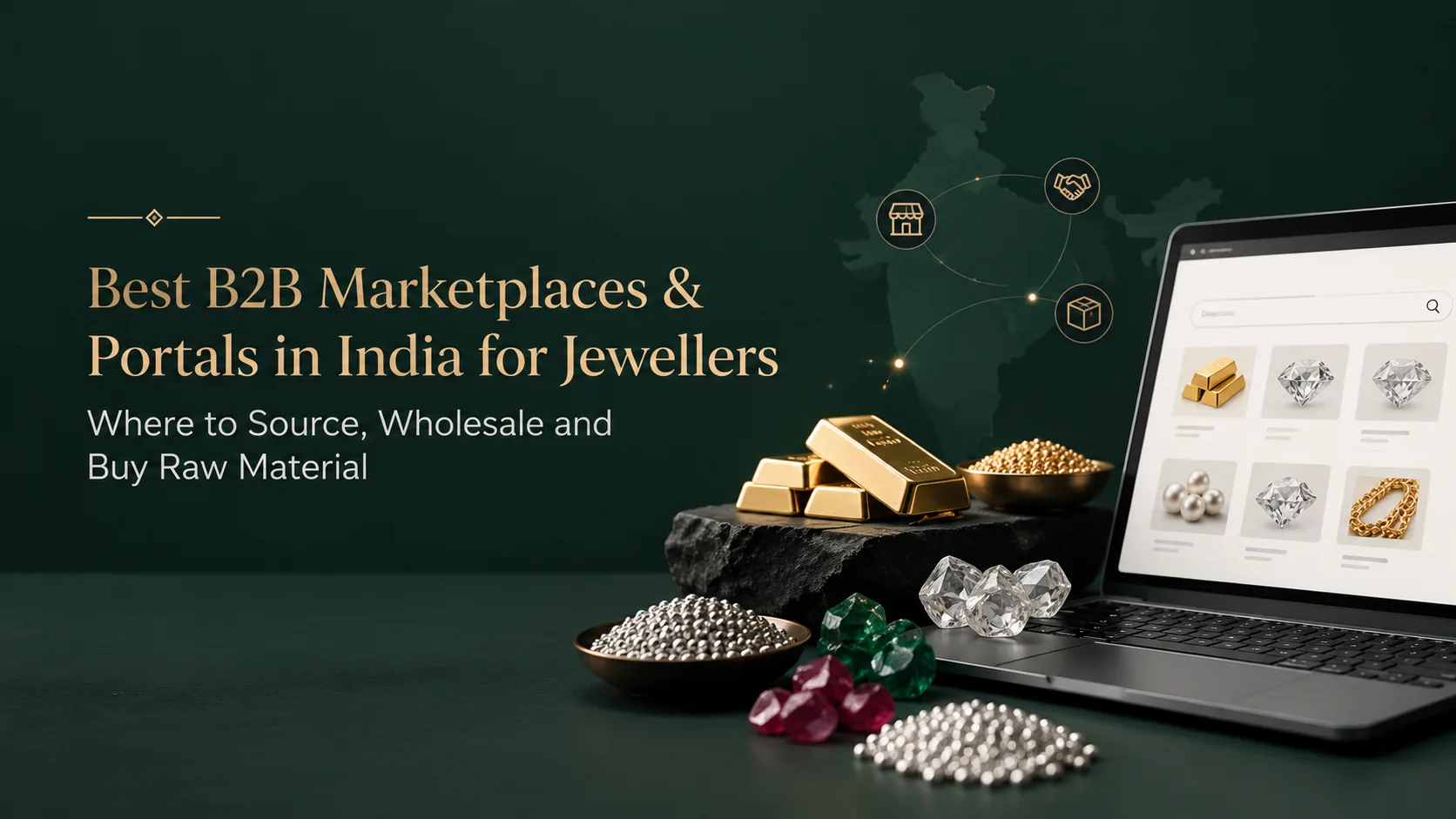
This guide covers the B2B marketplace India options that matter to the jewellery trade. It sorts general-purpose portals from jewellery-specific platforms, and sourcing channels from places where you list your own shop. For each platform, it says what it is good for, what it costs, and what to check before you trust it.
One distinction runs through the whole guide. A B2B portal helps you buy from or sell to other businesses: manufacturers, wholesalers, bullion dealers, tool suppliers. A consumer directory like GoldJewellers.in helps customers find your showroom. Most growing jewellers need both, for different jobs.
B2B Portals vs Local Jewellery Directories: Know Which Job You're Hiring For
Many first-time users mix these two up and waste money on the wrong one.
A B2B portal is built for trade. The people searching are other businesses: a retailer looking for a Kolkata casting unit, a manufacturer needing rhodium plating chemicals, an exporter looking for a hallmarked-gold wholesaler. Enquiries arrive as quotation requests, bulk orders, and catalogue downloads. Pricing is usually per kg, per gram, per piece, or per lot.
A local consumer directory is built for shoppers. The people searching are bride-to-be families, gold-coin buyers, people checking today's gold rate in their city, and people typing "jewellers near me." Enquiries arrive as walk-ins, calls, and direction requests. A listing like this brings footfall, not suppliers.
B2B portal | Consumer directory | |
|---|---|---|
Who searches | Jewellers, wholesalers, exporters, manufacturers | Shoppers and families |
What they want | Supply, rates, catalogues, bulk quotes | A trustworthy showroom nearby |
What a listing delivers | Trade enquiries and RFQs | Calls, visits, directions |
Typical cost model | Free tier plus paid subscription or lead credits | Often free basic listing |
Best for | Sourcing, wholesale selling, raw material | Retail footfall and local trust |
Treat them as two parts of one pipeline. The B2B side fills your showcases at the right cost, and the consumer side fills your showroom with buyers.
What a Jeweller Actually Needs From a B2B Platform
Before comparing platforms, name the job you want done. Jewellery trade buying breaks into four needs, and no single portal handles all of them well.
Finished jewellery sourcing. You buy ready stock from manufacturers and wholesalers: chains, bangles, bridal sets, kids' jewellery, silver, antique and CZ ranges. You need design catalogues, making charges, minimum order quantities, and delivery timelines.
Raw material. Bullion, alloys, findings, stones, solder, plating chemicals, packaging. Here the supplier's credentials matter more than the catalogue photos.
Machinery and tools. Casting machines, laser welders, polishing units, hallmark-compliant weighing scales, display fixtures.
Selling to the trade. If you also manufacture or wholesale, you need a place where retailers in other cities can find you.
Match the platform to the need. A general marketplace is strong for needs 2 and 3. A jewellery-specific app is strong for need 1. Trade events and networks serve all four, though slowly.
Top 10 B2B Portals in India for Jewellers (General and Jewellery-Specific)
The first five are general-purpose B2B marketplaces with active jewellery categories. The last five are built specifically for the gems and jewellery trade or run by trade media. Features and pricing change, so confirm current terms on each platform before you pay anything.
General B2B marketplaces are as follows:
1. IndiaMART
India's largest B2B marketplace, founded in 1996 and listed on the stock exchanges since 2019. Suppliers list for free, and buyers send enquiries or requests for quotation. Its business model is supplier subscriptions rather than transaction commissions.
Best for: bullion-adjacent suppliers, findings, packaging, tools, machinery, and finished jewellery from smaller manufacturers.
Watch for: paid plans reportedly run into tens of thousands of rupees a year, and lead quality varies by category. Free sellers see far fewer leads than paying ones. IndiaMART is a discovery platform, not an escrow or logistics provider, so payment protection is on you.
2. TradeIndia
Often described as India's second-largest B2B platform, with a freemium model of free listings and paid premium memberships. It leans slightly more towards exporters than IndiaMART does.
Best for: jewellery exporters and manufacturers wanting overseas buyer enquiries, and for comparing quotes you already got on IndiaMART.
Watch for: fewer total enquiries than IndiaMART in most categories, though some suppliers report more specific, serious buyers.
3. ExportersIndia
Operating since the late 1990s, it connects Indian manufacturers and exporters with international buyers. The supplier base is smaller than the two above.
Best for: export-ready jewellery makers, silver and fashion jewellery exporters, and jewellers looking for suppliers already used to international documentation.
Watch for: a smaller domestic retail audience, so use it as a complement rather than your only channel.
4. Alibaba.com
A global marketplace with a large jewellery category that includes Indian and Chinese suppliers.
Best for: imported findings, packaging, cheaper display fixtures, and comparing global price benchmarks for non-precious materials.
Watch for: import duties and customs paperwork. BIS rules apply to gold jewellery sold in India, so don't buy hallmark-bound gold items from overseas listings without checking compliance. Use it for accessories and consumables, not gold stock.
5. GlobalLinker
A business networking platform whose gems and jewellery category covers artisans and designers, gems and diamond exporters, gold and silversmiths, jewellery manufacturers, tools and supplies, and professional services.
Best for: networking, finding a designer or artisan, and discovering suppliers by city.
Watch for: it is a networking and directory-style platform, so expect conversations, not instant checkout.
Jewellery-specific B2B platforms and trade networks are as follows:
6. Sarafa Bazar India
A B2B app and website for makers, wholesalers and retailers, with a reported 10,000+ designs and a Play Store app that has crossed 10,000 downloads. The pitch is that a jeweller can browse manufacturers and wholesalers from the showroom instead of travelling to markets or expos.
Best for: retailers hunting new design catalogues and direct manufacturer contact across cities.
Watch for: it is a discovery layer. Agree rates, hallmarking, return terms, and payment schedule directly with the supplier.
7. CROWNSHOW
An online jewellery wholesaling platform that digitises the B2B buying and selling process. It describes curated retailers and manufacturers, unlimited linesheet exchange, and private interaction that mimics selling across the table.
Best for: retailers who like reviewing linesheets before committing, and manufacturers who want a controlled audience instead of an open marketplace.
Watch for: a curated model means access can be selective. Apply early and keep your business documents ready.
8. Jewelxy
A jewellery marketplace and no-code tool that helps jewellers build online stores and sell across multiple channels from one platform. Founded by Hemal Soni.
Best for: jewellers who want to add an online channel with minimal technical effort. This is more of a sell-side and growth tool than a pure sourcing portal.
Watch for: check how listing fees, commissions, and design ownership work before uploading your catalogue.
9. Jewel Trendz
Established in 2011 as a B2B business platform for India's gems and jewellery industry, combining business networking, exhibitions, industry events, and sales consultancy that connects manufacturers with retailers.
Best for: meeting manufacturers face to face, expanding into new territories, and building distribution relationships.
Watch for: it is event-led, so value depends on which shows you attend and how well you prepare.
10. GemGold (by The Retail Jeweller)
A curated, invitation-style sourcing platform for 22K and 18K gold and diamond jewellery, linking export-ready manufacturers from India and the Middle East with serious buyers. Its 2025 edition was held in Dubai.
Best for: jewellers serving diaspora customers, or importing and exporting gold and diamond jewellery.
Watch for: it targets higher-volume, export-oriented buyers, so it suits established businesses more than a single-showroom start-up.
Honourable mentions
GSI Stock Exchange, launched for jewellery manufacturers to source GSI-graded and certified diamonds, including matched pairs and melee parcels. It is relevant if you stock certified diamond jewellery.
Udaan and similar mobile-first wholesale apps work well for general retail and consumer goods. They are not built around gold jewellery, so test with consumables like packaging, display, and accessories rather than precious stock.
Free B2B Marketplace Options: What You Get for ₹0
A free B2B marketplace listing is a good way to test demand before you spend. Here is what free usually covers and where it stops.
What you typically get free:
A seller profile and company description.
A limited number of product listings with photos.
The ability to respond to direct enquiries that come to you.
Basic dashboard and mobile app access.
What is usually paid:
Priority placement in search results.
Access to buyer leads and requests for quotation.
Verification badges such as IndiaMART's TrustSEAL.
Larger catalogue limits and analytics.
Where free works for a jeweller:
Free listing on IndiaMART, TradeIndia and ExportersIndia. Create profiles with specific product names, not "gold jewellery." "22K gold casting chain, 10–40 gm, hallmarked" beats a vague title because buyers search by product detail.
Free networking on GlobalLinker. Useful for finding a designer, engraver or packaging supplier in your own city.
Free jewellery app browsing. Sarafa Bazar India and similar apps let you browse design catalogues without cost, so you can benchmark prices before negotiating with your regular supplier.
Free consumer directory listing. This is a different job, but it costs nothing, and it brings customers. If you are a retailer, list your showroom on GoldJewellers.in so shoppers can find you by city, and use the B2B portals for supply.
A practical rule: use free tiers for three months, track how many genuine enquiries come in, and only then decide whether a paid plan pays back.
B2B Lead Generation Services in India: What Works for Jewellers
If you are a manufacturer or wholesaler, you need buyers, not only suppliers. That is where B2B lead generation services in India come in. The label covers very different things, so here is what each option does.
1. Marketplace lead subscriptions (IndiaMART, TradeIndia). You pay for access to buyer enquiries in your category. Fast to start, but the same lead may be sent to several competitors, so response speed decides who wins. Reply within the hour with a rate range and catalogue link.
2. Trade-event lead generation. Exhibitions and curated sourcing events put you face to face with retailers. Leads are fewer but warmer. Bring a sample kit, a printed rate card, and a way to capture contacts immediately.
3. Catalogue and WhatsApp distribution. Many retailers prefer receiving a PDF or WhatsApp catalogue with weekly new designs. Build a broadcast list of verified retailers and update it on a schedule. This costs little and often converts better than portal leads.
4. LinkedIn and Google Business Profile. Retail chain buyers and procurement heads are on LinkedIn, and Google Business Profile helps wholesalers appear in local searches such as "gold chain manufacturer in Rajkot."
5. Outsourced agencies and sales consultancies. Some trade platforms and agencies run lead generation or performance-based sales consultancy for manufacturers. Before signing:
Ask for jewellery-trade references, not generic client lists.
Confirm whether you pay per lead, per qualified meeting, or per closed order.
Ask how leads are verified and whether you receive buyer contact details.
Avoid anyone who promises guaranteed orders.
6. Content and directory presence. A manufacturer with a clear website, city pages, and regular updates gets found by retailers who search directly. This is slow, but compounds, and it is cheaper than buying leads forever.
For most small manufacturers, a sensible stack is: one free marketplace profile, one trade event a year, a WhatsApp catalogue list, and a LinkedIn page. Add paid leads only after you know what a closed order is worth to you.
Trade Bodies, Expos and Physical Hubs That Work Like B2B Portals
Not every B2B channel is an app. In jewellery, the offline ecosystem is still where large orders get decided.
GJEPC (Gem & Jewellery Export Promotion Council). Organises India's biggest trade shows, including IIJS Premiere in Mumbai, and supports exporters with buyer-seller meets and registrations. Check the council's site for current dates and exhibitor details.
IBJA (India Bullion and Jewellers Association). The reference body for bullion rates and trade standards. Useful for rate benchmarks when you negotiate with bullion suppliers.
Regional jewellery shows. City associations in Jaipur, Chandigarh, Kolkata, Hyderabad and elsewhere run shows that gather local manufacturers and nearby retailers.
Traditional bazaars. Zaveri Bazaar in Mumbai, Burrabazar in Kolkata, Sarafa lanes in Indore and Rajkot's gold hubs remain wholesale centres. Many suppliers there now also share catalogues digitally, so you can shortlist online and visit only the ones that fit.
Use a B2B portal to find the shortlist, and the trade event or market visit to confirm quality before placing your first big order.
Verification Checklist Before You Trust Any Supplier
Anyone can create a profile. Whether you source through a portal, an app, or an agent, run through this list before the first payment.
GST number and legal name. Verify it on the government GST portal and match it with the invoice name.
BIS hallmarking compliance. Gold jewellery sold in India must follow BIS hallmarking rules, including HUID. Ask whether the supplier is a BIS-registered jeweller or works through a hallmarking centre, and confirm every piece you receive carries the mark.
Purity testing. Test the first lots at an independent hallmarking centre before scaling up.
Physical address. Ask for a video call of the workshop or shop. For larger orders, visit.
References from other jewellers. Ask for two retailers who have bought from them for a year or more, and call them.
Payment terms in writing. Agree the making charge, wastage percentage, gold rate reference, and return policy before the order.
Sample before bulk. Order a small lot and compare weight, finish, and hallmarking against the catalogue.
Insurance and transit. For gold shipments, confirm insured courier or bullion-secure transit.
Avoid advance-only deals with unknown sellers. No portal's "verified" badge replaces your own due diligence.
Check how your supplier's purity claims line up with your own customers' questions too. Shoppers often search for [916 vs 750 vs 833 purity explained], so stock labelled and certified correctly protects your reputation.
Which Platform Fits Which Type of Jeweller?
Single-showroom retailer buying ready stock. Start with Sarafa Bazar India and CROWNSHOW for catalogues, use IndiaMART for packaging and display, and attend one regional show a year.
Multi-store chain or regional brand. Combine GJEPC events and manufacturer relationships with Jewel Trendz networking and direct supplier contracts. Portals become a secondary sourcing check.
Small manufacturer wanting retail buyers. Free profiles on IndiaMART, TradeIndia and ExportersIndia, a WhatsApp catalogue list, and a trade event. Add paid leads once you can respond within an hour.
Exporter or diaspora-focused jeweller. ExportersIndia, TradeIndia, GemGold and GJEPC buyer-seller meets.
Jeweller going online. Jewelxy-style tools for the online store, plus a consumer directory listing for local discovery.
Diamond and certified-stone buyer. GSI Stock Exchange and trade-body channels, with certificates verified at source.
Where GoldJewellers.in Fits Into Your B2B Strategy
GoldJewellers.in is a consumer-facing gold jewellery store directory for India. It does not replace a sourcing portal, and it is not meant to. It does a different job: when a shopper searches for a jeweller in their city, your store should be visible.
Here is how the two sides work together in practice:
Source smartly through B2B portals so your stock mix, pricing and margin are right.
Be found by customers through a clear store listing with correct name, city and address.
Keep your online presence consistent. The name, address and phone on your B2B profile, Google Business Profile, and directory listing should match, because mismatches confuse both customers and search engines.
Use the trade-facing and customer-facing content together. Customers check [today's gold rate in your city] before they visit, so keep your own rate board and making-charge information current.
If you run a store and have not claimed your listing yet, do that alongside your B2B profiles. It costs little and covers the retail side while your sourcing side is being built.
Conclusion
India's jewellery trade is shifting from "who do you know" to "who can you verify." The portals above give you faster discovery, wider choice, and real price benchmarks, but they don't replace samples, hallmark checks, references, and clear terms.
A workable plan for this quarter:
Create free profiles on IndiaMART and TradeIndia with precise product titles.
Browse Sarafa Bazar India and CROWNSHOW to benchmark designs and rates.
Pick one trade event and prepare for it.
Verify every new supplier with the checklist above.
Claim or update your showroom listing so customers can find you.
Platform features, pricing, and event dates change often. Verify current details on each official site before you commit.