











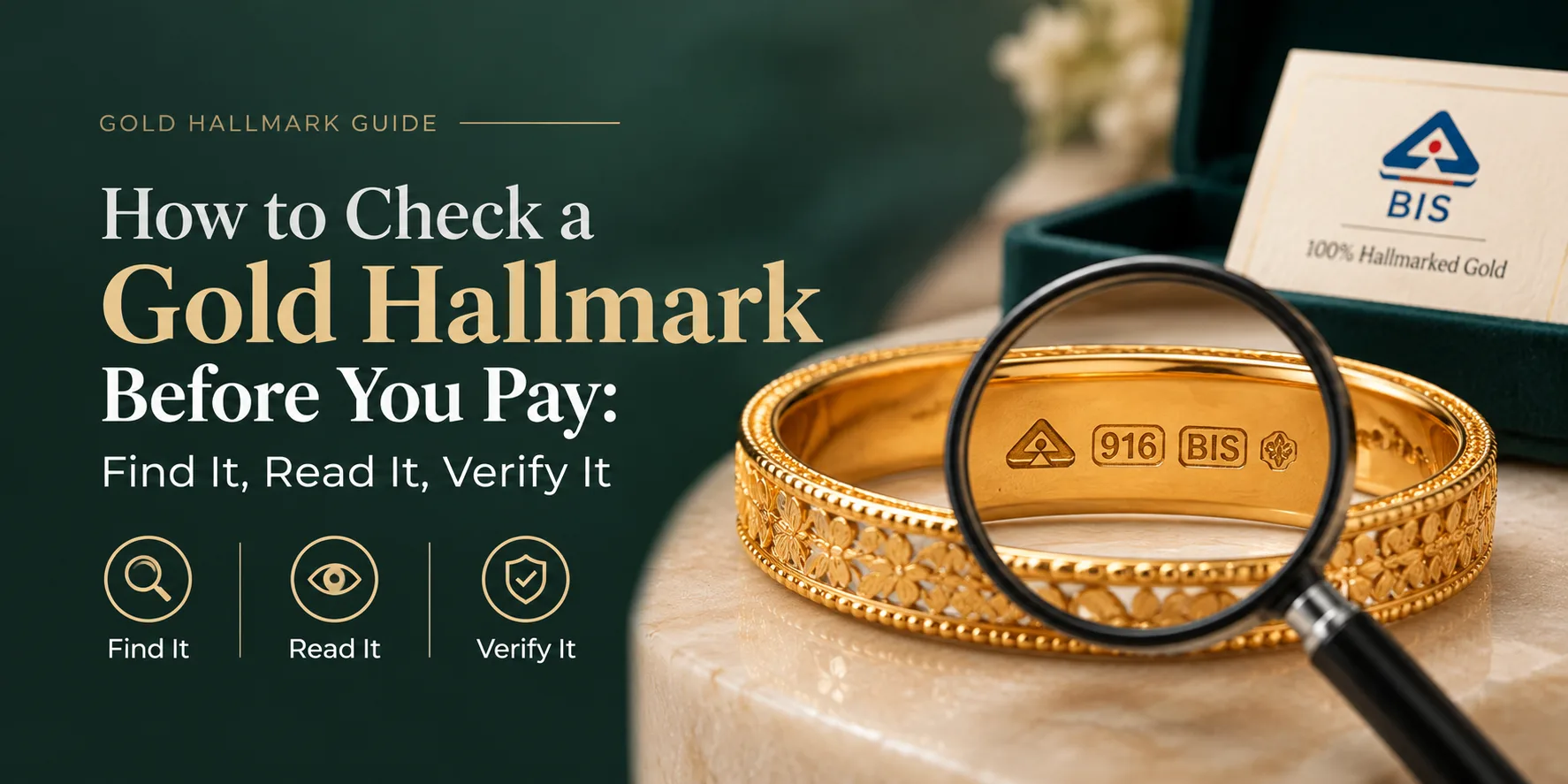







The jeweller has pulled out a chain you like. The tag says 22K, the price looks fair, and the billing machine is already warming up. This is the moment to check the hallmark, and with a loupe and your phone it takes about three minutes.
This guide is built for that moment. It does not explain what 916, 750 or 999 stand for, because our hallmark purity numbers guide already covers that. Here you will learn where the stamp hides on a chain, ring, bangle or earring, how to read the four official marks one by one, how to spot a stamp that looks wrong, and how to confirm everything on the BIS Care app before any money changes hands.
What to Carry Into the Shop
Take a 10x jewellery loupe, because hallmarks are tiny and the letters on a ring band can be smaller than a grain of rice. Take your phone with the torch working, since counter lights bounce off polished gold and wash out shallow marks.
Install the BIS Care app at home while you have good signal, because showrooms in malls and basements often have none. Keep a notes app open for the HUID and the weight, so you can compare both with the bill.
Ask politely if you can examine the piece yourself. A jeweller who sells genuine hallmarked gold is used to this and will often hand you their own loupe.
Where to Find the Hallmark on Gold Jewellery
The usual reason a buyer says “there is no hallmark on this” is that they looked at the front of the design. Stamps sit where they will not catch on clothes or skin, which means hidden surfaces.
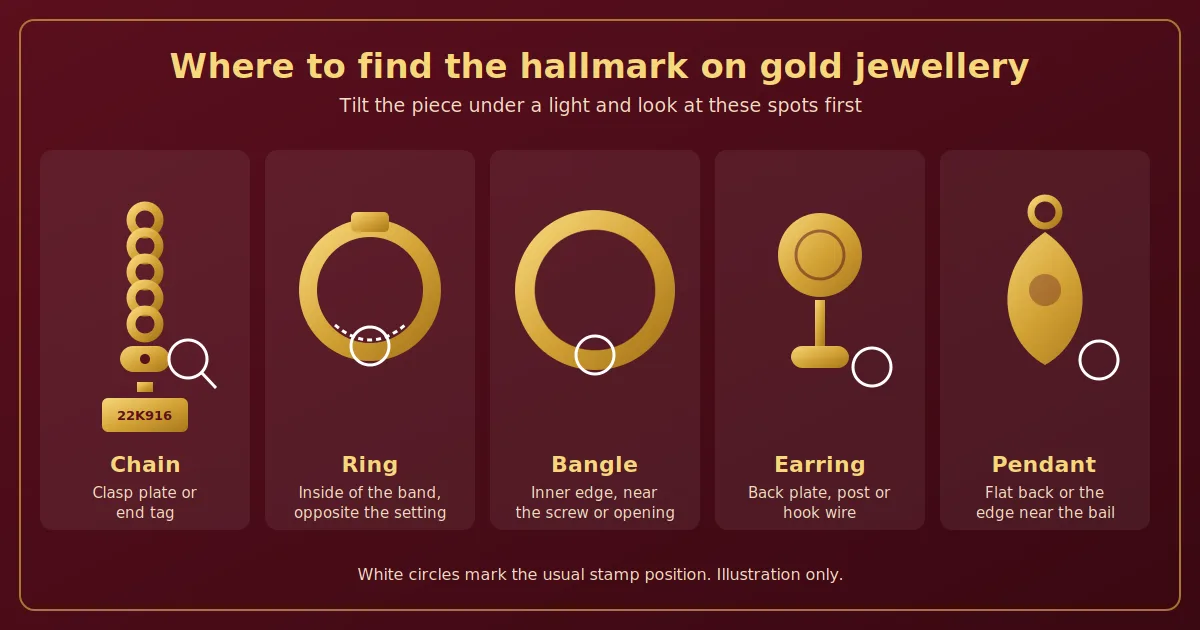
Rings. Turn the ring and read the inside of the band, usually opposite the setting. On thin bands the marks run in one tight line. On wide bands they may sit in two short rows.
Bangles and kadas. Check the inner edge, often close to the screw, clasp or opening. Each bangle in a pair should carry its own marks. One stamped bangle and one blank one calls for a question.
Earrings. Look at the back plate, the post or the curve of the hook wire. Studs have the least room, so the marks may sit on the flat back of the cup that holds the post.
Pendants and lockets. Start with the flat back. If the back is domed or decorated, check the edge near the bail, the small loop the chain passes through.
Mangalsutra and necklaces. The marks sit on the gold clasp, the end cap or a small tag, and sometimes on the back of the main pendant. The black beads are not hallmarked, so do not look for a stamp on them.
If you cannot find marks after a careful look under torch light, ask the jeweller to point to them. A genuine piece has a place where they sit, and showing it takes five seconds.
How to Check Hallmark on Gold Chain
Chains cause the most confusion because they are mostly links, and links are too small and round to hold a stamp. The marks sit on the other parts.
Start with the clasp. On a lobster clasp the marks usually sit on the flat side of the body, and on a hook or box clasp they sit on the plate or tongue. Flip the clasp over, because the stamp is often on the underside. Next, check the end tag, a small oval or rectangular piece attached to the last link by a ring. On lighter chains it is the most common spot. Last, look at any connector ring between the chain and the clasp.
Three chain problems come up often:
A loose tag. A tag is part of the article, but it should be firmly closed to the chain. If it comes off easily, ask why and make sure it stays with the chain through billing.
A shortened chain. Shops resize chains at the counter. If the marked end was cut off, ask whether the piece was re-marked after the change, and verify the HUID on the app anyway.
A mismatched clasp. The clasp and tag should match the links in colour and warmth. A bright yellow clasp on a paler chain deserves a second look.
Thick men’s chains in Cuban or rope styles have wider clasps, so the marks read easily. You can browse chains and jewellery for men and necklaces from verified sellers to see how listings describe hallmark details before you visit a shop.
How to Check Hallmark on Gold: The Three-Minute Method
This sequence is the same for every piece, which stops you from skipping a step when the salesperson is chatting.
Find the marks using the placement list above. Look yourself first, then ask the jeweller to confirm.
Light and magnify. Hold the torch low and to the side, close to the surface. Bring the piece up to the loupe, not the loupe to the piece, so your hands stay steady. Tilt slowly until the letters stand out.
Read the marks in order, left to right: the BIS logo, the purity, then the code or other marks.
Photograph the stamp with your phone. You will type the HUID from this photo, and it is a record if there is a dispute later.
Verify on the app, then compare the result with the tag and the bill.
Do all five on each piece. If you are comparing three chains, do not carry results from one to the next.
The 4 Hallmark Symbols and How to Read Each Mark
A traditional BIS hallmark has four parts, and many older pieces still carry all four. Newer pieces use a changed format, covered at the end of this section. First, how to read each mark.
1. The BIS logo
The BIS logo is a small triangle, and it is the first mark to look for. It shows the piece was hallmarked under Bureau of Indian Standards rules, not a private shop’s own system.
Under the loupe, a genuine logo is a clean, closed triangle with sharp corners and even line thickness. Be wary of a triangle that looks rounded, has a gap in one side, or sits at an odd angle to the other marks. Some private symbols imitate the triangle from a distance, and the loupe is how you tell them apart.
2. The purity grade
This mark gives the karat and the fineness together, for example 22K916. The purity numbers guide has the full chart, so your only job here is to check that the grade matches what you were told.
Compare three places: the stamp, the price tag and the salesperson’s words. A tag that says 22K above a stamp reading 18K750 is the most common mismatch. Sometimes it is an honest tagging error, but either way the stamp wins, because it is the tested value and the price should follow it. Also check that the karat and fineness belong together: 22K goes with 916, 18K with 750.
3. The assaying centre mark
The third mark identifies the Assaying and Hallmarking Centre that tested the piece. It is a small symbol or short code that ties the piece to a real BIS-recognised laboratory, so a disputed piece can be traced back.
You cannot decode it by eye, and you do not need to. Check that it is present, sharp, and in the same style as the other marks. A mark that is deeper or larger than its neighbours looks like it was added later.
4. The jeweller’s identification mark
The fourth mark identifies the registered jeweller who made or sold the piece, usually as a small logo, initials or a short code. Many shops sell ready-made pieces from wholesale manufacturers, so the mark may belong to the maker rather than the shop. That is normal. What matters is that the bill names the seller and that BIS Care returns a registered jeweller.
What changed on newer pieces
Pieces hallmarked under the current rules carry three parts: the BIS logo, the purity grade and a six-character alphanumeric code called the HUID. The assaying centre and jeweller details are no longer stamped as separate symbols. They are stored against the HUID in the BIS database, and you read them on the app. So a new piece with three marks is missing nothing, and an old piece with four marks is not outdated. It also explains why the app check matters most on new jewellery.
How to Identify Hallmark Gold That Looks Wrong
None of these signs proves fraud alone. A cluster of them is a reason to slow down and verify.
The marks look hand-punched. Current hallmarks are laser etched, shallow, sharp and evenly spaced. Deep, wobbly or crooked marks on a new piece look like a hammer and die.
The characters differ in depth. All characters in one hallmark should look like one machine pass. A purity number deeper than the logo beside it suggests the marks were added at different times.
There is no BIS logo. A stamp showing only “22K” or “916” without the triangle is a private claim, not a BIS-tested one.
Two pieces carry the same HUID. Each article gets its own code. Identical codes on two chains or two bangles will usually show up in the app check.
The weight on the tag does not match the scale. That is a billing problem even if the hallmark is fine.
If you are unsure, do not argue at the counter. Photograph the marks, thank the jeweller and run the app check.
How to Check BIS Hallmark on Gold With the BIS Care App
Steps to verify the HUID on the BIS Care app: install, tap Verify HUID, enter the code, match the result
BIS Care is the Bureau of Indian Standards’ own app for checking certified products, and its Verify HUID feature is built for this check. It is free to download and use.
Install the right app. Search for BIS Care on the Google Play Store or Apple App Store, and check that the publisher is the Bureau of Indian Standards, because copycat apps exist.
Open Verify HUID on the home screen.
Enter the six-character code exactly as stamped. If your version offers a camera scan of the laser mark, allow camera access, though typing from your close-up photo works just as well.
Read the result. The record should describe the piece in your hand.
Typing the code without mistakes
A HUID mixes letters and digits, and laser marks are tiny. The usual confusions are the letter O and the digit 0, I and 1, B and 8, S and 5. Use your zoomed photo, not memory. If two characters could be read two ways, try both. A wrong guess returns no record or a record for something else, so a failed first attempt means check your typing before suspecting a fake.
What to match in the result
The record typically shows the registered jeweller, the article type, the purity and hallmarking details.
What the app shows | Compare it with |
Jeweller name | The shop board and the bill |
Article type | The piece in your hand (chain, ring, bangle) |
Purity | The stamp and the tag |
Hallmarking details | Should be plausible for a new piece |
If every line agrees, you have done a proper check. A different jeweller name is not automatically a problem, since a manufacturer may hallmark and a retailer may sell, but the retailer should be able to explain it. If the article type says ring and you are holding a bangle, stop.
If the app is slow, BIS also runs a web lookup at huid.manakonline.in, which reads from the same records. Open it in your phone browser, or step to the door for better signal.
Mistakes Buyers Make During the Check
Trusting the tag over the stamp. Tags are printed by the shop. The stamp and the app record are the tested facts, so read them first and the tag last.
Checking only one piece from a set. A matching bangle or earring pair can differ from its partner. Check each item.
Verifying after paying. A mismatch is easy to sort out before billing and slow to sort out after. Do the app check while the piece is still on the counter.
Photographing the whole piece instead of the stamp. A wide shot does not let you read the HUID later. Take the close photo with the loupe or with your phone zoomed in.
Accepting “the hallmark is on the box.” The marks belong on the article itself. A box or a card can describe a piece, but it cannot replace the stamp.
What to Match Before You Pay
Run through this list with the piece still in your hand:
The BIS logo is present on the main body or a firmly attached part.
The purity on the stamp, tag and quoted price all agree.
The HUID returns a record on BIS Care, and the record describes the same article and purity.
The jeweller on the record connects to the seller on the bill.
The tag weight matches the scale.
The bill lists purity, HUID or hallmark details, net weight, rate and making charges separately.
Authenticity and price are separate questions. To judge the price, compare the day’s rate on the gold rates page and read why gold prices are rising and how rates are calculated.
Special Cases That Confuse Buyers
Old family jewellery with no HUID. Pieces hallmarked before the HUID system carry older marks and no code to enter, so the app cannot look them up. To confirm purity before selling or exchanging, use a purity test at a BIS-recognised centre or a trusted valuer.
Studded jewellery. The hallmark certifies the gold, not the stones. On a diamond ring or a polki necklace, verify the gold as usual and ask for separate paperwork on the stones. The diamond jewellery category lists stores that sell stone-set pieces with detailed documents.
Very light items and traditional work. Some very light articles and certain traditional categories, such as kundan, polki and jadau, can fall outside mandatory hallmarking. If such a piece has no marks, ask which rule applies and check the BIS website for the current list of exemptions.
Bridal sets. With ten or fifteen pieces, check the marks on every item, not just the largest. Stores in the bridal jewellery and antique jewellery categories handle this volume regularly.
If the Hallmark Does Not Match
Do not pay or take the piece. If you paid a token amount, keep the receipt.
Ask for an explanation. Show the photo of the stamp and the app result. Many mismatches are clerical, such as a wrong tag.
Ask for a corrected bill or a replacement that matches the stamp, the tag and the app.
Keep your evidence: app screenshots, close photos of the stamp, the bill and the date.
Report it if the answer does not hold up. The BIS Care app has a complaints feature, and you can also complain through the BIS website. A missing hallmark on a piece billed as hallmarked, or a HUID that does not match the record, are both valid grounds.
You do not need to accuse anyone. Verification is a normal part of buying gold, and a genuine jeweller will not take offence.
Check Before You Buy
A hallmark check takes a habit, not a skill. Find the marks, read them under light, verify the code and match the result to the bill. Repeat on the next piece.
When you are ready to shop, browse BIS-hallmarked jewellers on Gold Directory, filter by your city, and compare stores before you walk in. You can also look at trusted jewellers, explore gold jewellery collections, or start with rings, bangles and earrings.