
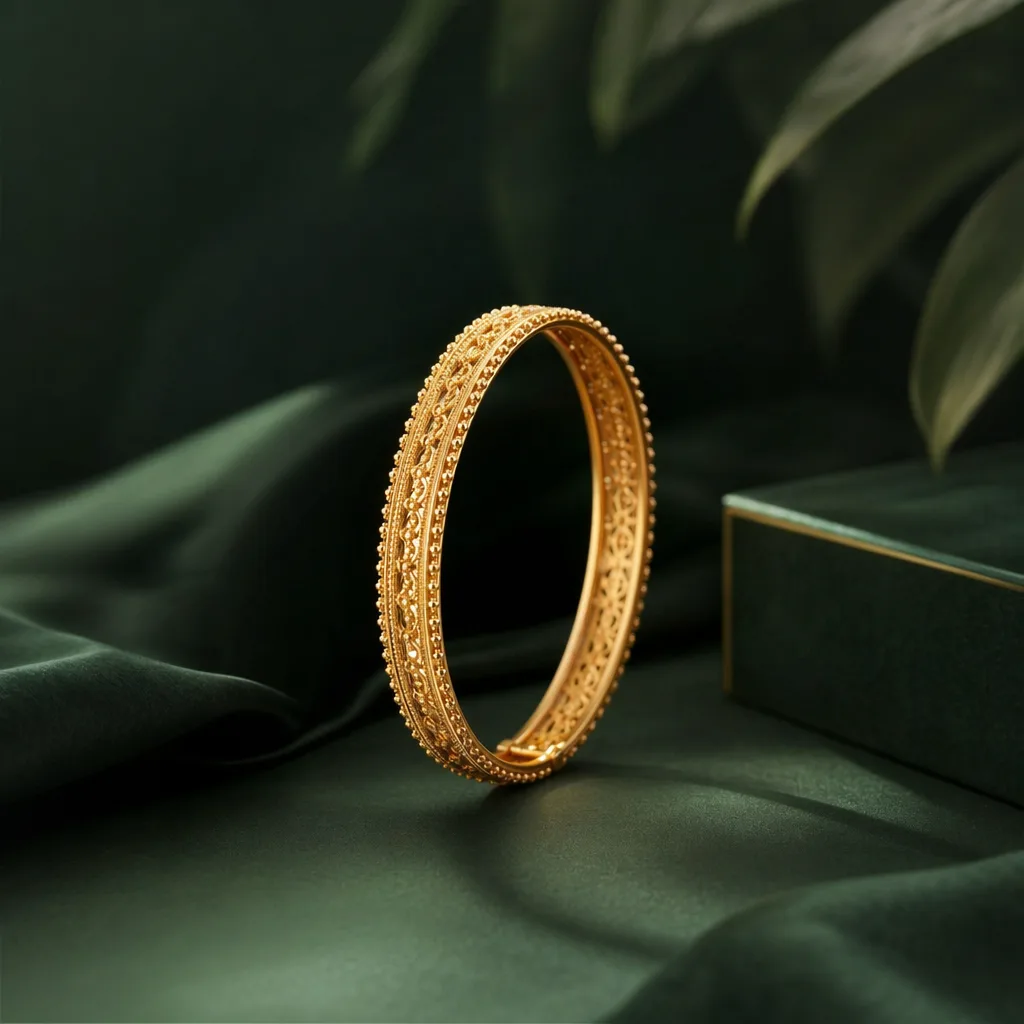
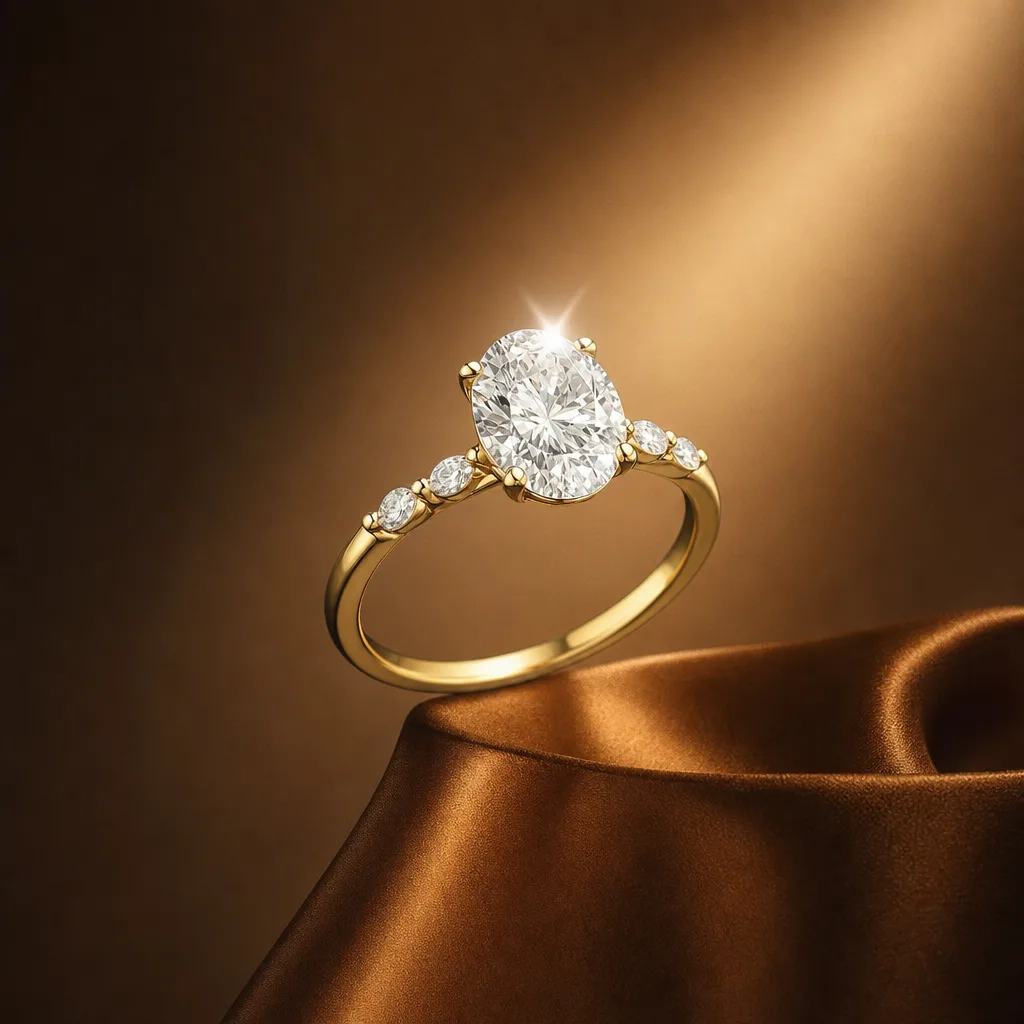


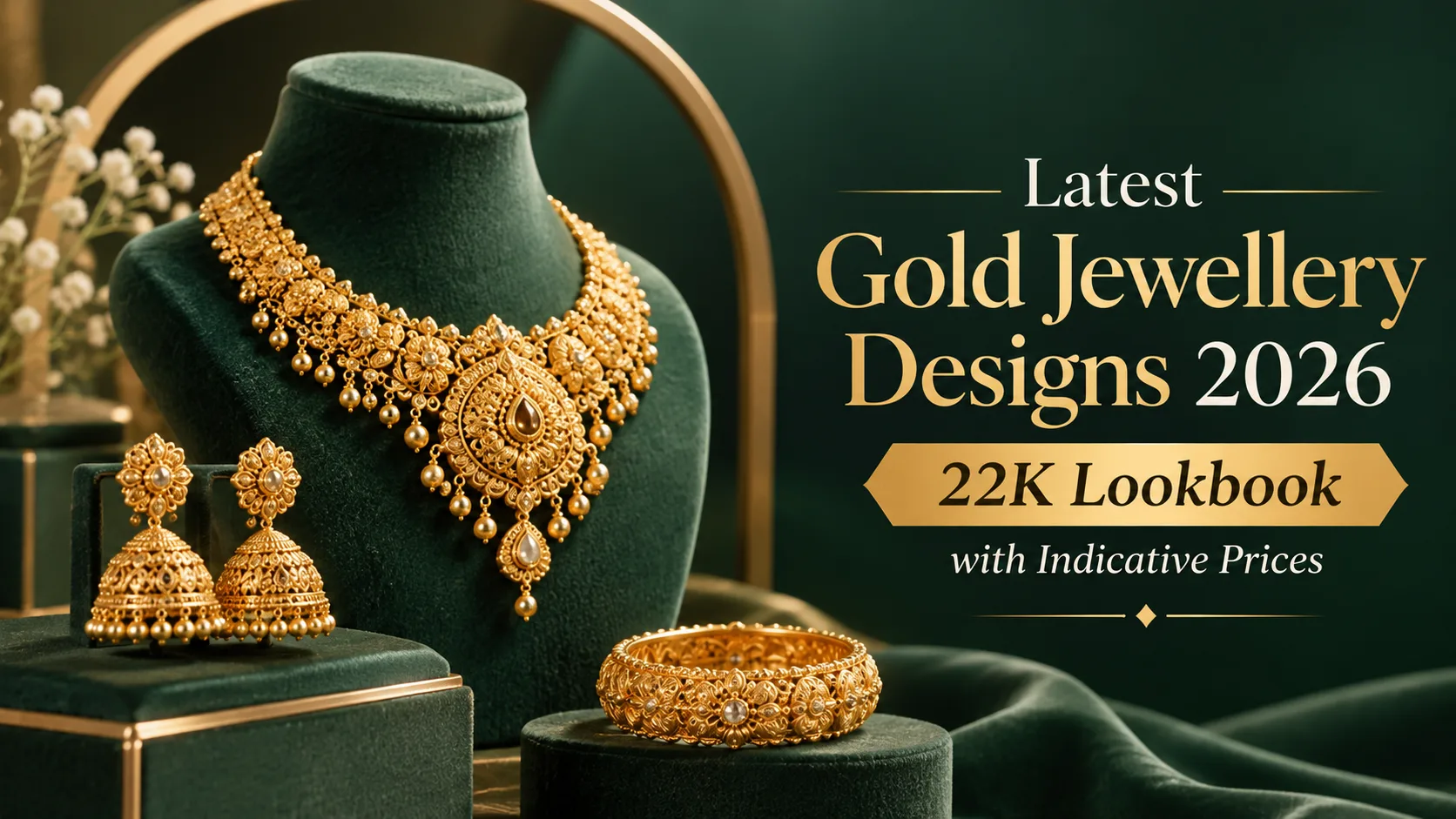
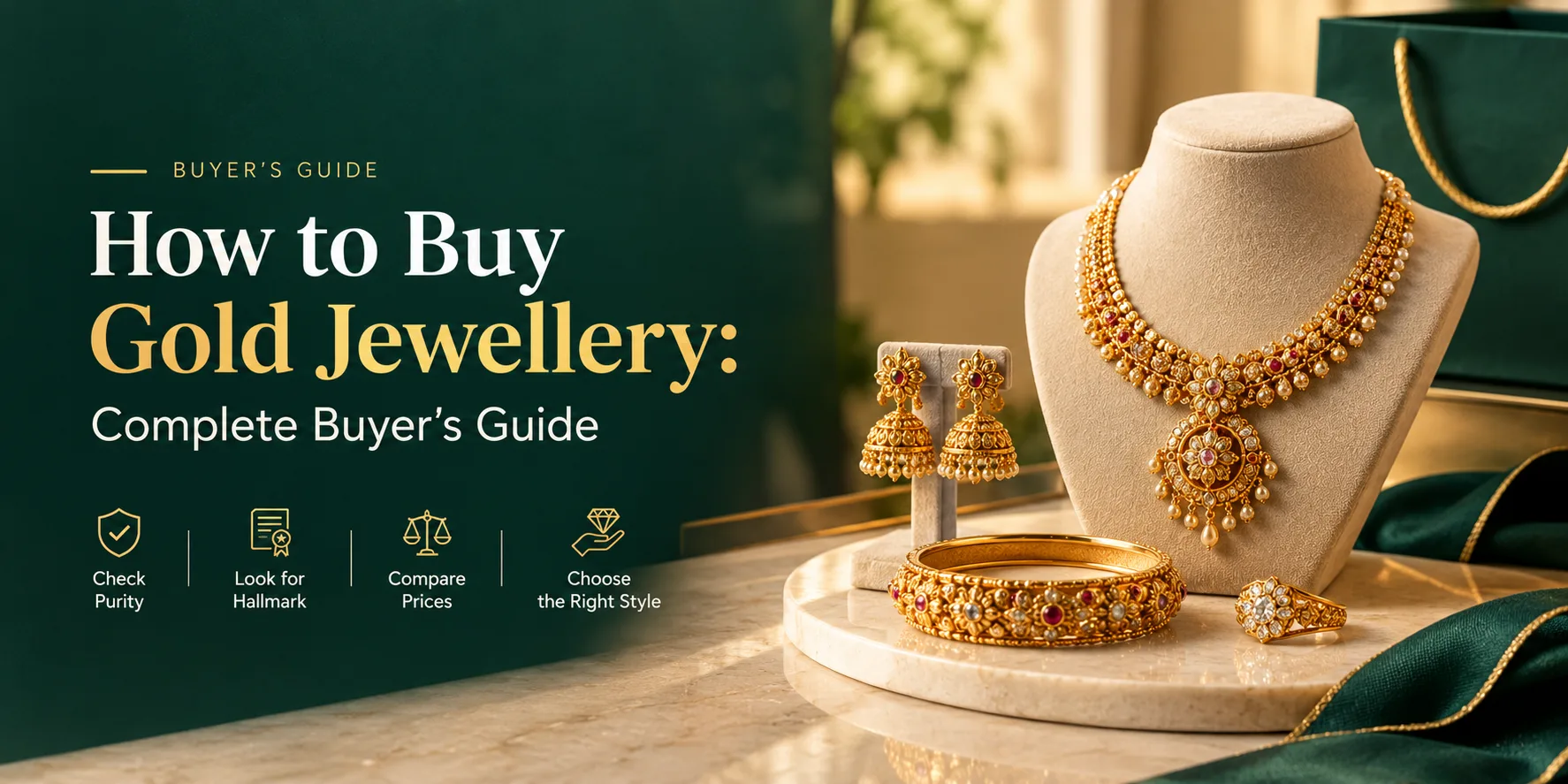


Gold jewellery designs change slowly, but the way people shop for them has changed a lot. Most buyers now spend weeks looking at necklaces, jhumkas, and mangalsutra patterns online before they walk into a shop. This lookbook is written for that stage. You are not buying today. You want to know what is worth asking for, how heavy it will be, and roughly what it will cost.
Every design here is 22K gold, meaning 916 purity: 91.6% pure gold mixed with a little copper, silver, or zinc so it holds its shape. It is the standard for Indian wedding and festival jewellery, and if you are unsure why not 24K, our guide to 22K vs 24K gold explains the trade-off. We cover the six groups buyers search for most: temple jewellery, mangalsutra, necklace sets and rani haar, jhumkas, South Indian bridal sets, and the price ranges that go with them.
How this lookbook is put together
We describe designs the way jewellers across India actually make and sell them, region by region, and we attach weights and price ranges you can test against a real quote. We do not reproduce any brand's catalogue images or claim a particular shop stocks a particular piece. Every store on Gold Jewellers has a profile with its city and address, and you can send an inquiry to ask whether a design is available. That last step matters, because a hand-made piece is rarely sitting in the showcase exactly as you imagined it.
Two things we have kept deliberately simple. First, prices are shown as ranges, never single numbers, because the same design in the same city can differ by lakhs depending on weight and making charges. Second, we focus on what is common in 2026 showrooms: lighter 22K pieces for daily and festive wear, and traditional heavy sets for the wedding itself.
What 22K gold jewellery costs: read this before the numbers
The final price of any gold piece is not a catalogue figure. It is a formula:
Price = (weight in grams x today's 22K rate + making charges) + 3% GST
Making charges are the jeweller's fee for crafting the piece. They are quoted either as a percentage of the gold value or as a flat amount per gram, and they range widely: machine-made chains sit at the low end, while hand-finished temple work and stone-set pieces sit at the high end. Stones, pearls, enamel and beads are billed separately from the gold weight. Our guide on how to buy gold jewellery goes deeper into making charges and negotiating.
Here is a worked example with a pair of 10 g plain gold jhumkas at a rate of ₹15,000 per gram, 12% making charges and 3% GST:
Gold value: 10 x 15,000 = ₹1,50,000
Making charges at 12%: ₹18,000
Subtotal: ₹1,68,000
GST at 3%: ₹5,040
Total: about ₹1,73,000
For the table below, we used a 22K rate of about ₹15,000 per gram, which matches the average 22K rate shown on our gold rate today page on 31 October 2026 (₹15,013 per gram), with charges between 8% and 25%, and 3% GST. That works out to roughly ₹16,700 to ₹19,300 per gram all-in. These are indicative ranges, so check your own city's rate before you compare, whether that is Chennai, Hyderabad, or Ahmedabad.
Design | Typical gold weight | Indicative price range |
|---|---|---|
Lightweight daily-wear jhumkas (pair) | 3 to 6 g | ₹50,000 to ₹1.2 lakh |
Statement or temple jhumkas (pair) | 8 to 15 g | ₹1.3 lakh to ₹2.9 lakh |
Short daily-wear mangalsutra | 4 to 8 g | ₹67,000 to ₹1.55 lakh |
Long nallapusalu or chain mangalsutra | 15 to 30 g | ₹2.5 lakh to ₹5.8 lakh |
Necklace with matching earrings | 20 to 40 g | ₹3.3 lakh to ₹7.7 lakh |
Temple necklace | 25 to 60 g | ₹4.2 lakh to ₹11.6 lakh |
Rani haar | 50 to 120 g | ₹8.4 lakh to ₹23 lakh |
Full South Indian bridal set | 150 to 400 g | ₹25 lakh to ₹77 lakh |
If the market moves 5% in either direction, so does every row. That is why a price you saw on a brand's website last month, including the ones people search for as a Tanishq latest gold necklace set designs with price query, will not match today's tag.
Branded chains publish a per-design price that is calculated from the rate on the day. Use their figure as a reference for design and weight, then recalculate with the current rate.
Temple jewellery: the design that never leaves the shortlist
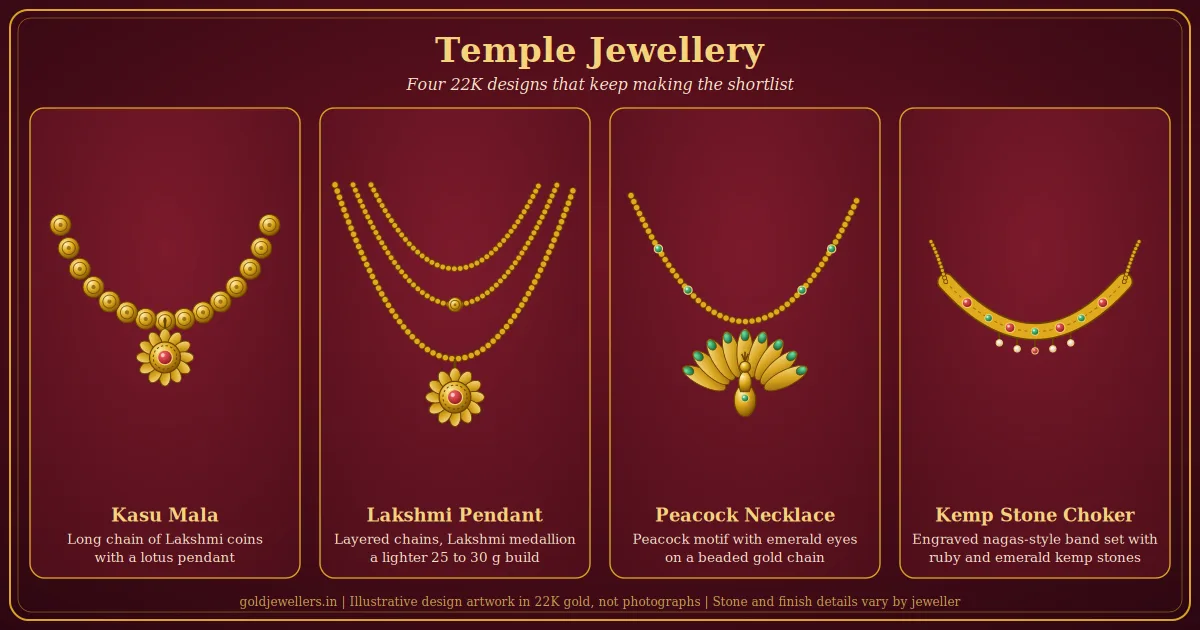
Temple jewellery is gold jewellery inspired by South Indian temple art. It features deities such as Lakshmi, motifs like peacocks, lotus petals, and coins, and a matte, antique-style finish. It started as adornment for temple idols and dancers and is now a staple of South Indian weddings.
What the latest temple jewellery designs in gold look like in 2026:
Coin and kasu mala necklaces remain the most requested. A kasu mala is a long chain strung with gold coin-shaped motifs, often stamped with Lakshmi. It photographs beautifully and is simple enough to wear again at festivals.
Lakshmi pendants on layered chains are popular with younger brides who want a temple look without 60 g of gold on the neck. Think a 25 to 30 g piece instead of a 60 g one.
Peacock and annapakshi motifs. The peacock is a long-time favourite. The annapakshi, a mythical swan-like bird, appears in finer Andhra and Tamil work.
Nagas work is the traditional hand-engraved detailing on the surface. It is what separates a hand-finished temple necklace from a machine-cast one, and it is what pushes the making charge toward the upper end of the range.
A first-hand tip that saves real money: temple pieces often carry kemp stones (red or green synthetic or semi-precious stones) and sometimes pearls. Ask for the net gold weight separately from the gross weight.
A 40 g temple necklace with heavy stone work may contain far less gold than the number suggests, and the stone weight should not be priced at gold rates. For 22K gold temple jewellery designs with price, always ask the shop to show gross weight, stone weight, and net gold weight on the estimate.
If you want the antique matte look specifically, browse the antique jewellery category and ask each shop to show you the finish in person. Finish varies, and it looks different under shop lights than in photos.
Mangalsutra designs: latest gold patterns by region
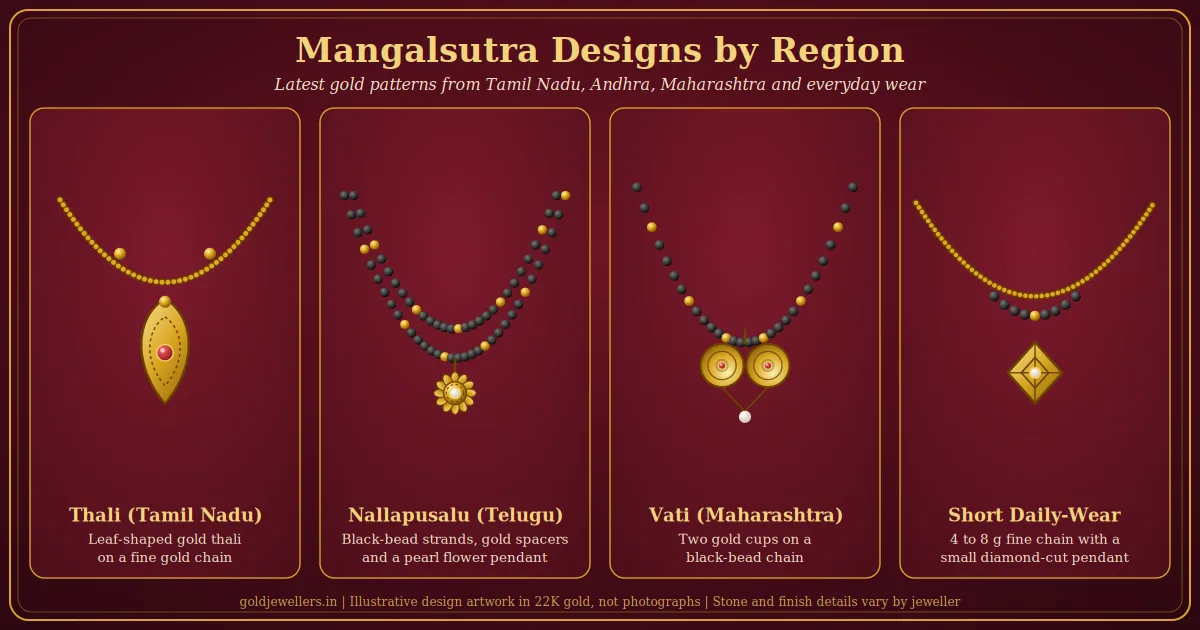
A mangalsutra is the sacred necklace a married woman wears, traditionally a gold pendant or beads on a thread or chain. Its name and form change by region, which is why mangalsutra designs in gold are one of the most searched jewellery terms in India.
Tamil Nadu: the central piece is the thali (or thirumangalyam), tied at the wedding itself. Many families keep the original thali and add a separate chain for daily wear.
Andhra Pradesh and Telangana: the pustelu and the nallapusalu. Nallapusalu are black beads (nalla means black, pusalu means beads) strung in a chain with gold spacers and a pendant.
When people search for the latest nallapusalu designs in gold, jewellers such as Lalitha Jewellery are among the names that come up, but the style is made by many local jewellers across both states. The latest versions are shorter, with a single gold pendant, so they work with office wear.
Maharashtra: the vati mangalsutra, with two small cup-shaped gold pieces (vati) on a black bead chain, remains the classic, while newer versions use a single diamond-cut gold pendant.
What is trending now across all regions:
Short daily-wear mangalsutra at 4 to 8 g, with a fine chain and a small pendant. This is the biggest shift in the latest gold jewellery designs: brides now ask for two, one traditional for ceremonies and one light for everyday.
Black bead chains with gold motifs spaced between beads, which let you control the gold weight tightly.
Long chain mangalsutras of 15 to 30 g for festive and wedding occasions.
A practical point: the black beads are glass or other material and are not gold. Price the gold weight, not the total piece weight.
If you want branded options for comparison, look at what national chains like Tanishq offer for mangalsutra designs on their own sites, then use them to compare weight and finish against local jewellers. Local makers usually match the same patterns at different making charges. Our directory lets you browse necklaces from listed jewellers to see what is available.
Necklace sets and rani haar: from choker to chest-length
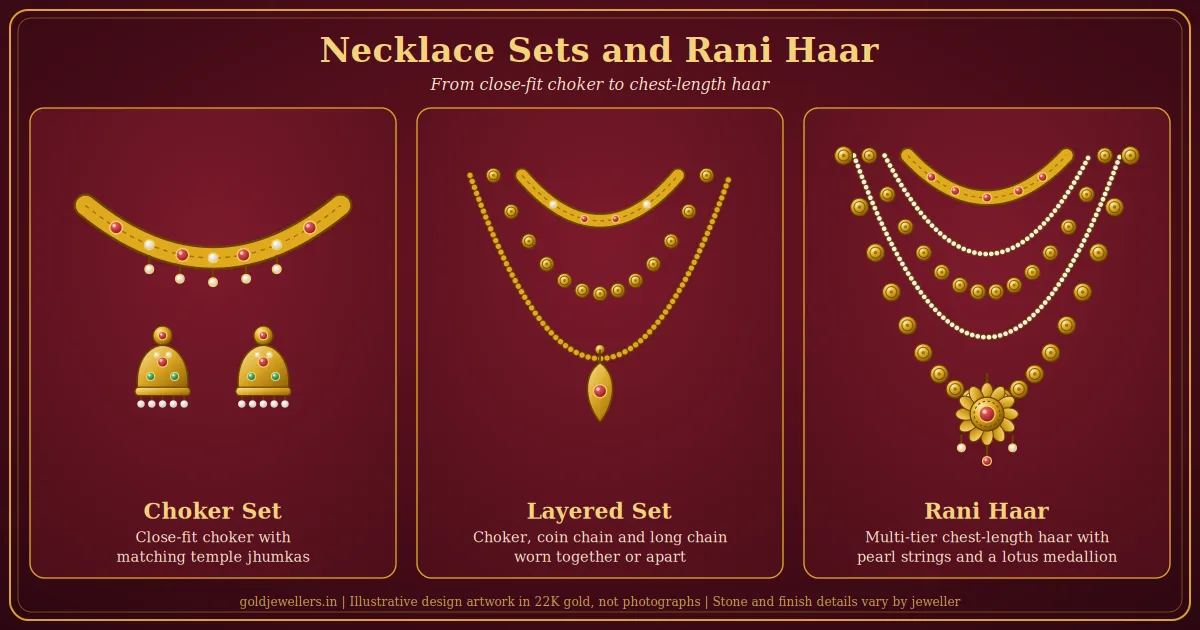
A necklace set is a necklace sold with matching earrings, sometimes with a maang tikka (forehead ornament). A rani haar is a long, multi-layered necklace that rests on the chest, traditionally worn by brides and by the lady of the house at large celebrations. The word rani means queen.
The latest gold necklace set designs we see most often:
Choker sets. Close-fitting, 20 to 40 g, usually with matching jhumkas. Good for sleeveless or boat-neck blouses and the lowest-risk first purchase for a wedding trousseau.
Layered sets. A choker plus a medium chain plus a long drop, made to be worn together or separately. This gives you three necklaces for the weight of one big one.
Rani haar in lighter builds. The traditional rani haar can weigh 100 g. The 2026 version often runs 50 to 70 g by using hollow or semi-hollow construction, where the inside of the piece is empty, to keep the look big and the weight down.
Hollow gold is perfectly valid, but ask whether the piece is hollow, because it is more fragile and some jewellers repair or exchange it differently. Ask about the exchange value in writing.
Kundan and polki accents (uncut diamond-style stones set in gold) inside a gold frame, especially in north and west India. These carry very different making charges because of the setting labour, so ask for a line-item estimate. Browse bridal jewellery to see what stores in your city list.
Rani haar prices swing the most of any category. A 60 g piece and a 110 g piece look similar on a mannequin but are priced almost twice apart, so decide your weight first and shop designs within that weight.
Jhumkas: the one piece that always makes the list
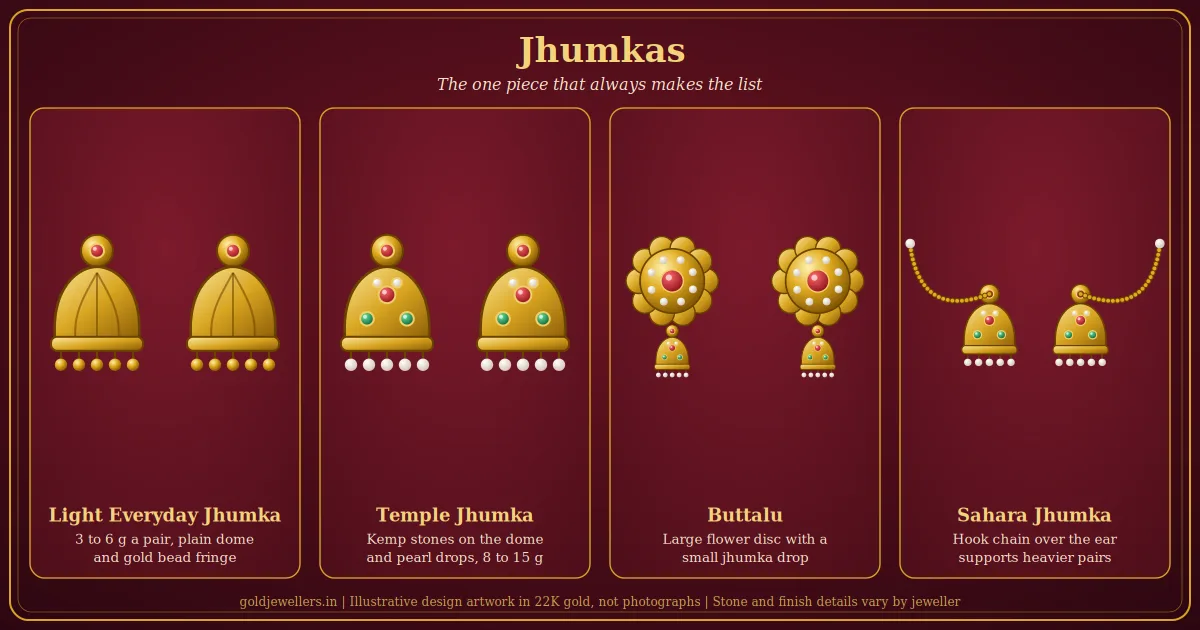
A jhumka is a bell- or dome-shaped drop earring, usually with small gold balls or beads hanging from the rim. It is the most universal piece in Indian jewellery, worn with sarees, lehengas, and kurtas alike.
Latest 22K jhumka designs:
Light everyday jhumkas at 3 to 6 g a pair, with a plain dome and a small drop. These suit daily wear and are the entry point for gifting.
Temple jhumkas with Lakshmi or peacock motifs and kemp stones, typically 8 to 15 g a pair.
Buttalu, the large round or flower-shaped earrings popular in Andhra Pradesh and Telangana, sometimes layered with a jhumka drop beneath.
Chain-supported (sahara) jhumkas with a small hook chain over the ear for heavier designs. This is a useful detail: anything over 10 g needs support or the earlobe will complain by evening.
The gold weight limits what you can comfortably wear, so try the jhumka on, preferably for a few minutes, before you confirm it. Browse listed earrings to compare styles from different stores.
South Indian bridal sets: what is in a full 22K set
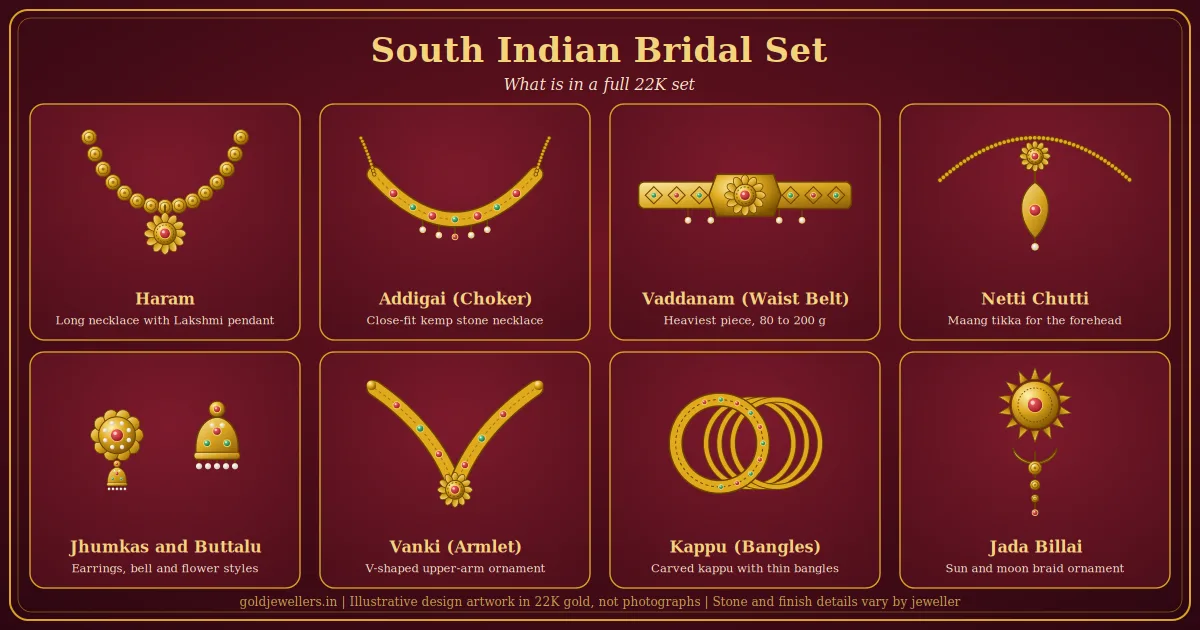
Searches for the latest gold jewellery designs for a South Indian wedding usually mean a full bridal set. The components are traditional, and knowing the names helps when you speak to a jeweller:
Haram: the long necklace, often with a Lakshmi pendant
Addigai or choker: the close-fitting necklace
Vaddanam (oddiyanam in Tamil): the gold waist belt, the heaviest single piece
Netti chutti or maang tikka: the forehead ornament
Jhumkas and buttalu: earrings
Vanki: the armlet
Kappu or bangles: worn in sets
Jada billai: the braid ornament
Families usually buy the haram, choker, jhumkas, and bangles for the wedding and add the vaddanam later or borrow it, because the vaddanam alone can run 80 to 200 g.
What has changed in the latest South Indian bridal designs:
Mixed weights. Instead of one heavy set, brides pair a heavy haram with lighter, reusable pieces.
Mix of temple and plain gold. Plain polished bangles sit alongside heavily worked temple pieces so the set looks balanced.
Lighter, hollow vaddanam. Brides who want the look without 150 g at the waist are choosing hollow builds.
The indicative range for a complete bridal set runs from ₹25 lakh at 150 g to over ₹77 lakh at 400 g on the assumptions in our table. A 100 g starter set that covers haram, jhumkas, and bangles is a realistic ₹17 lakh to ₹19 lakh.
Allow six to eight weeks for hand-made temple sets, and ask for the delivery date in writing, ahead of your muhurtham date. If the shop makes the set to order, ask whether the rate is locked on the order date or priced on the delivery date. That one question can change the final bill by thousands.
Why you still see 2020 and 2021 designs in search results
People still search for latest gold jewellery designs 2020 and latest gold jewellery designs 2021, and those pages still rank. The reason is that gold design cycles are slow.
A good temple necklace from 2020 is still on sale in 2026, and only the finish, weight, and styling advice have moved. So an older catalogue can still be useful for shape and motif. Where it fails is the price. Any price printed in a 2020 or 2021 catalogue is out of date, because the gold rate is far higher now. Use old designs for ideas and today's gold rate for money.
Hallmarking: the check that matters more than the design
A gorgeous design is no good if the gold is below the stated purity. Every 22K piece should carry a BIS hallmark, which shows the purity grade (916 for 22K), the assaying centre mark, the jeweller's mark and a HUID, a six-character code unique to that piece.
Before paying, read how to check a gold hallmark, and if a shop offers an older piece with no hallmark, read hallmark gold vs KDM gold and what fake hallmark gold costs buyers.
How these pieces connect: the chain from design to price
It helps to see how the pieces relate. A design (temple, kundan, plain) decides the craft involved. Craft decides the making charge. The making charge, together with net gold weight and the day's 22K rate, decides the price.
Stones and beads change the gross weight but not the gold weight. Hallmarking sits underneath all of it, because it confirms that the 22K you are paying for is 22K.
On the occasion side, a wedding drives demand for heavy sets (rani haar, bridal set, vaddanam), while festivals such as Diwali, Dhanteras and Akshaya Tritiya drive demand for lighter pieces (jhumkas, short mangalsutra, bangles) and for coins.
Region links design to custom: Tamil and Telugu weddings lean on temple work, nallapusalu and the vaddanam, Maharashtrian weddings on the vati mangalsutra, and Rajasthani weddings on jadau and kundan. Knowing your own family's customs before you shop narrows a list of hundreds of designs down to a handful.
Where to see these designs in person
Online images only get you so far. Gold and diamond jewellery looks different in hand, and the weight on the scale is the only number that counts. Use Gold Jewellers to find stores by city and send inquiries before you visit. Some places to start:
In Bengaluru, stores such as Bhuramal Rajmal Surana Jewellers, whose listing highlights jadau jewellery, and Joyalukkas Rajaji Nagar
In Coimbatore, Coimbatore Jewellers near the Salem new bus stand
In other cities, browse Hyderabad, Pune, Jaipur, or Kolkata jewellers for the best trending design gold jewellery, or pick any other city from the city list
We list a store's name, city, and address, so confirm what each shop stocks by inquiry.