







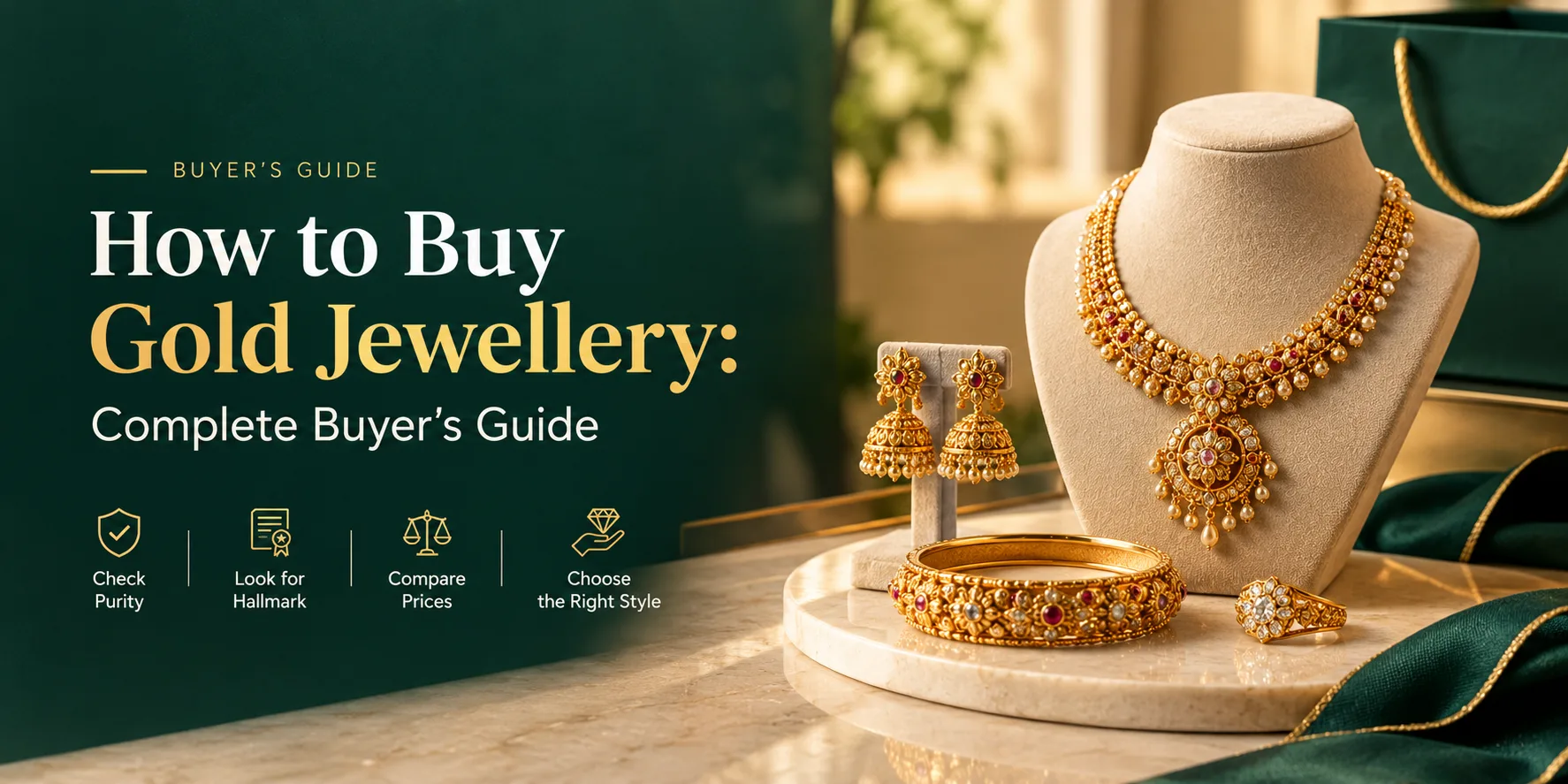





Most people start buying gold jewellery in the wrong order. They walk into a shop, fall for a design, and only then ask what it costs. By that point, the conversation is about the piece, not the price, and the weight, rate, making charges, and GST all arrive on one slip of paper with very little room to compare.
This guide reverses the order. Do the thinking at home first: fix a budget, pick a purity, learn where a shop's rate comes from, know which charges can move, and decide what you will do with the jewellery later (wear it, gift it, exchange it or sell it). After that, shop-hopping gets quick, because you are comparing the same five numbers at every counter.
If you are buying for a wedding or a festival, give this page an hour. Each section links to a deeper guide where one exists, so you can stop at the level of detail you need.
The Short Version
If you only read one section, read this one. How to buy gold jewellery comes down to eight checks, in this order:
Set the budget as a weight in grams, then add everything on top of the gold.
Pick the purity that suits how the piece will be used.
Check the shop's rate against a benchmark on the same day.
Convert making charges into rupees per gram so shops can be compared.
Confirm the hallmark and the stones, briefly.
Negotiate the parts of the bill that can move.
Get the exchange and buyback terms in writing.
Time the purchase around rate movement and your muhurat, not just the calendar.
Step 1: Set the Budget in Grams, Not Just Rupees
A rupee budget is the weakest way to plan a gold purchase, because the weight it buys changes every day. A better method is to decide the grams you want, then work out the full cost on top.
Your final bill is not the gold rate multiplied by weight. It has four layers: the value of the gold, the making charge, any stone or diamond charge, and 3% GST on the whole invoice value, making charges included. A small hallmarking fee is usually added per piece as well.
Worked example showing gold value, making charge, stone charge and GST adding up to the final bill for a 20 g 22K necklace
Here is the same example in a table. It uses an illustrative rate of ₹13,000 per gram for 22K gold, close to where Mumbai has been trading in recent weeks, but the method matters more than the number.
Item | Working | Amount |
|---|---|---|
Gold value | 20 g x ₹13,000 | ₹2,60,000 |
Making charge | 12% of gold value | ₹31,200 |
Stone charge | Plain gold piece | ₹0 |
Subtotal | ₹2,91,200 | |
GST | 3% of subtotal | ₹8,736 |
Total | ₹2,99,936 |
Divide the total by the gold weight, and you get about ₹14,997 per gram. That all-in number is the one to carry from shop to shop. A shop with a lower gold rate but a higher making charge can easily cost more than one with a slightly higher rate and a lean making charge.
Two planning habits help with weddings in particular. First, split the list into pieces you will wear (chains, bangles, daily earrings) and heavy one-time pieces again.
The second group carries high making charges that you will not recover later, so keep it as small as the occasion allows. Second, hold back about 5% of the budget for upgrades at the counter, because stone changes and design tweaks almost always add to the estimate.
Step 2: Pick the Purity for the Job
Purity decides how the piece wears and how it is priced. For most buyers, the real choice is between 22K and 18K.
Purity | Fineness | Best for |
|---|---|---|
24K | 999 | Coins and bars, not wearable jewellery |
22K | 916 | Traditional jewellery, bridal sets, temple and plain gold work |
18K | 750 | Diamond and gemstone jewellery, daily wear, lighter designs |
22K is the Indian default for traditional pieces because it balances gold content and durability. 18K is harder and holds stones more securely, which is why most diamond jewellery uses it. For a deeper comparison, read our guide to 22K vs 24K gold.
One point that rarely gets explained: lower purity does not automatically mean lower total cost. The 18K rate per gram is about 75% of the 24K rate, against roughly 91.6% for 22K, so the gold itself costs less. But if the shop charges a flat making charge per gram, that part of the bill is the same on 18K and 22K. Ask which method the shop uses before you assume 18K will be cheaper.
Step 3: Gold Rate in Jewellery Shop Today: What the Number Means
Search for the gold rate in jewellery shop today, and you will see five different figures from five different websites. None of them is necessarily wrong. They answer slightly different questions.
Four layers between the bullion benchmark and the final invoice, showing why shop gold rates differ
Where the differences come from. The published benchmark rate is indicative and usually quoted before GST and other levies. Many websites round it, show it per 10 grams instead of per gram, or update it only a few times a day. A city adds its own premium. Then each jeweller sets a board rate for the day, which can be a little above or below the benchmark. So when you check today gold rate in jewellery shop listings online, treat the figure as a reference point, not a price.
What the 22K rate should look like. The 22K rate is about 91.6% of the 24K rate. If a shop's 22K board rate does not line up with its own 24K board rate, ask why. It is a quick consistency check that takes ten seconds.
What a gap is worth. Suppose the benchmark 22K rate is ₹13,070 per gram and a shop quotes ₹13,300. The gap is ₹230 per gram, which is ₹4,600 on a 20 g piece before any making charge is added. A gap of a few tens of rupees is routine. A gap of a few hundred is worth a question.
Gold price in jewellery shops is more than the rate. The jewellery shop gold price you actually pay is net gold weight times the board rate for that purity. Gross weight, which includes stones and sometimes the clasp or lining, is not the same thing. Always ask for the net gold weight and check that stone weight has been subtracted.
Gold Rate in Mumbai Jewellery Shops
Mumbai is where a large share of India's gold is traded and finished, and the Zaveri Bazaar area packs thousands of jewellers into a few lanes. That competition keeps board rates tight. When you compare gold rates in Mumbai jewellery shops, you will often see small differences in the rate itself and larger ones in making charges. Branded showrooms and mall stores commonly quote a similar gold rate but recover their costs through higher making charges and less room to negotiate. For a daily reference, use our live gold rate page or the Mumbai gold rate page.
Lock the Rate Before You Commit
If you are placing an order for later delivery, ask whether the shop offers a rate lock. A small advance, often a portion of the estimated value, fixes the rate for a set period.
The terms to ask about are the lock period, whether only the gold rate or also the making charge is fixed, and what happens to the advance if you cancel. The best version is a lock that gives you the lower of the booking-day rate and the delivery-day rate. Not every shop offers it, but many will agree if you ask before paying.
Step 4: Decode the Making Charges
Making charges are where the biggest differences between two shops usually sit, and where most buyers have the least information.
Percentage or per gram. Some shops quote making charges as a percentage of gold value. Others quote a flat amount per gram. A percentage rises when gold rises. A flat charge does not. To compare shops, convert everything into rupees per gram: 12% on a ₹13,000 rate is ₹1,560 per gram.
Wastage is part of the labour cost. Some jewellers show "wastage" or "VA" as a separate line, and some fold it into the making charge. Ask for both and add them. The number that matters is total labour per gram.
Indicative making charge ranges by design type, from plain machine-made chains to bridal and kundan work
Design decides the range. The ranges below are indicative and vary by shop, city, and design, but they show how the pricing logic works.
Design type | Indicative making charge | Why |
|---|---|---|
Plain machine-made chains, coins | 3% to 8% | Fast to produce in volume |
Machine-made bangles, light sets | 8% to 14% | More finishing, more varied designs |
Handcrafted, temple, antique | 15% to 25% | Hand work and longer production time |
Bridal, kundan, very fine work | 20% to 30% or more | Skilled labour, high breakage and finishing time |
Light pieces cost more per gram. A 3 g pair of earrings with a 25% making charge looks small in rupees, but it has a worse labour-to-gold ratio than a 40 g plain bangle at 9%. If you are buying many small pieces, the combined labour cost adds up faster than the total weight suggests.
Stones are priced separately. Check that the weight of stones, enamel, or lac is deducted from gross weight, and that stones are billed on their own line. Remember that most stones are valued at little or nothing if you sell the piece later.
You do not get making charges back. Gold you resell is valued on its weight and purity. The labour you paid for is gone. That is the strongest argument for keeping heavy, high-labour pieces to a minimum and for buying coins or bars if you want pure investment exposure.
Step 5: Check the Hallmark, Stones and Shop (Briefly)
You will find plenty of detail on these elsewhere, so here is only what you need at the counter.
Hallmark. Every hallmarked piece should carry the BIS logo, the purity grade, and a six-character alphanumeric HUID. Check that the purity on the piece matches the purity on your estimate. Our guide on how to check gold hallmark walks through the symbols, and hallmark purity numbers explained covers 916, 750, 833 and 999.
Diamonds and gemstones. For diamonds, the four Cs (cut, colour, clarity, carat) set the price. For most jewellery, ask for a certificate on stones above about 0.30 carat and make sure the certificate number matches the piece.
The shop itself. Reviews are useful when you read the right ones. Skip "beautiful collection" and look for comments on billing transparency, how the shop handled exchange or buyback, and whether the final bill matched the estimate. To start with shops that carry BIS certification, use our directory of BIS-certified jewellers.
Step 6: Negotiate the Parts That Can Move
Haggling over the gold rate rarely works, because it is tied to the market. The parts of the bill that can move are narrower, but they are worth real money.
What is negotiable: making charges, wastage, stone charges on some pieces, and extras such as a free coin or a waiver on certain fees.
What is not: the benchmark gold rate, GST, and the hallmarking fee.
Some tactics that work better than a general "give me a discount":
Ask for written estimates from three shops for pieces in the same weight band, then compare the all-in cost per gram from Step 1.
Negotiate making charges as a rupees-per-gram number, not as a percentage discount. A "10% off making charges" claim can be less than it sounds if the starting number was inflated.
Bundle your purchases. If you are buying three or four pieces, ask for the making charge on the heaviest or simplest piece to be reduced or waived.
Read festive offers carefully. "Up to 25% off making charges" often applies only to selected designs. "Zero making charges" may be recovered through a higher rate or a cap on weight.
Check what a saving scheme actually gives you. The popular 11-month plans where the jeweller adds a final instalment usually have conditions: redemption only at that shop, limits on designs, and sometimes making charges on top.
On payment, there is no price advantage in paying cash, and income tax rules do not allow a seller to accept ₹2 lakh or more in cash for a single transaction. Use bank transfer, UPI or card for larger bills, which also leaves a clean payment record.
Step 7: Can We Sell Gold in Jewellery Shops? Exchange vs Buyback
Think about resale before you buy, not after. The question many buyers ask only later is whether they can sell gold in jewellery shops, and the answer is yes. Most jewellers buy gold, not only their own. But the price depends heavily on which route you take.
What you get back and what you lose when you exchange or sell gold jewellery
Two routes. An exchange gives you credit toward a new purchase. A buyback pays you in cash or by bank transfer. Exchange credit is often more generous because the shop keeps your business. Buyback offers are usually lower and vary more between shops.
How jewellery shops buying gold value your piece. The process is straightforward. The shop tests purity, often with an XRF machine that does not damage the piece, or with a touchstone. It weighs the piece, removes the stone weight, applies the day's rate for the tested purity, and then deducts a melting or refining charge. That deduction is where shops differ most.
Route | What you typically get | What to watch for |
|---|---|---|
Exchange at the same shop | Gold value at or near the day's rate | Whether making charges are deducted from the old piece's value |
Exchange at a different shop | Gold value less a deduction | Deduction percentage and whether hallmark is required |
Buyback for cash | Gold value less melting deduction | Rate used (day of sale or invoice day) and payment method |
Old pieces without hallmark | Gold value based on tested purity | Higher deduction, testing charges, and ID proof requirements |
What you do not get back. Making charges, GST on the original invoice, the hallmarking fee, and in most cases stone or diamond value. This is why buying plain, low-labour pieces gives you a better resale position than heavy ornate sets.
Ask these questions before you buy:
What percentage of the day's rate will you pay on exchange and on buyback?
Does the policy apply to pieces from other shops?
Is there a time window, and does the piece need the original invoice?
Are stones taken back, and at what value?
Get the answers on the invoice or a printed policy, not as a verbal promise. When you sell, carry ID proof, and ask for a receipt that states weight, tested purity, rate, and deduction. For larger amounts, take payment by bank transfer.
One tax note: profit on selling gold jewellery is taxed as capital gains, and the holding period that separates short-term from long-term is 24 months. Speak to a chartered accountant before a large sale.
Step 8: Timing Around Price Dips and Auspicious Dates
Nobody can reliably call the bottom of the gold market, and waiting for the perfect dip is a common way to miss a wedding deadline. A more practical plan is to spread risk across purchases.
A three-tranche plan to buy gold jewellery through price swings: book now, buy on a dip, collect the final piece
Buy in tranches. Split your planned weight into three parts. Book the first with a rate lock, add the second if the rate dips below your booking-day level, and take the final piece close to the event. This does not require predicting anything. It just reduces the damage of a single bad day.
Know what moves the rate. Large moves usually follow a few triggers: changes in import duty announced in the Union Budget (the July 2024 cut in customs duty is a clear example), decisions on global interest rates, and movements in the rupee. If a trigger is coming up, avoid placing a large order on the day itself.
Plan for demand peaks. Shops get busiest around Akshaya Tritiya, Dhanteras and the main wedding months. The gold rate does not carry a fixed festive premium, but queues are long, popular designs sell out and there is less time to compare. The upside is that festive campaigns often cut making charges, so read the terms and compare against your Step 1 numbers.
Auspicious dates and practical timing. If your family wants to buy on a specific muhurat, such as Akshaya Tritiya, Pushya Nakshatra or Dhanteras, check the panchang for that year and work backward. A practical approach is to select the design and book it weeks earlier, then complete the purchase on the day. If you cannot get the main set on the muhurat, buy a small coin or a light piece on the day and take the larger set when the shop is less crowded.
For weddings, work to a timeline. Start observing rates about three months before the date. Place custom or handmade orders six to eight weeks ahead, because intricate work takes time. Keep the last two weeks for fitting, final checks and billing, not for major decisions.
Your Pre-Shop Checklist
Take this with you, or screenshot it.
Budget set in grams and in total rupees, with a 5% buffer.
Purity decided for each piece (22K, 18K).
Benchmark rate noted on the day, with time.
Estimates from at least three shops, converted to all-in cost per gram.
Making charge and wastage as separate lines, in rupees per gram.
Net gold weight and stone weight on the estimate.
HUID on every piece, matching the purity on the bill.
Exchange and buyback terms written on the invoice.
Payment by bank transfer, UPI or card for larger amounts.
Invoice kept safe, with no cut-outs or missing pages