











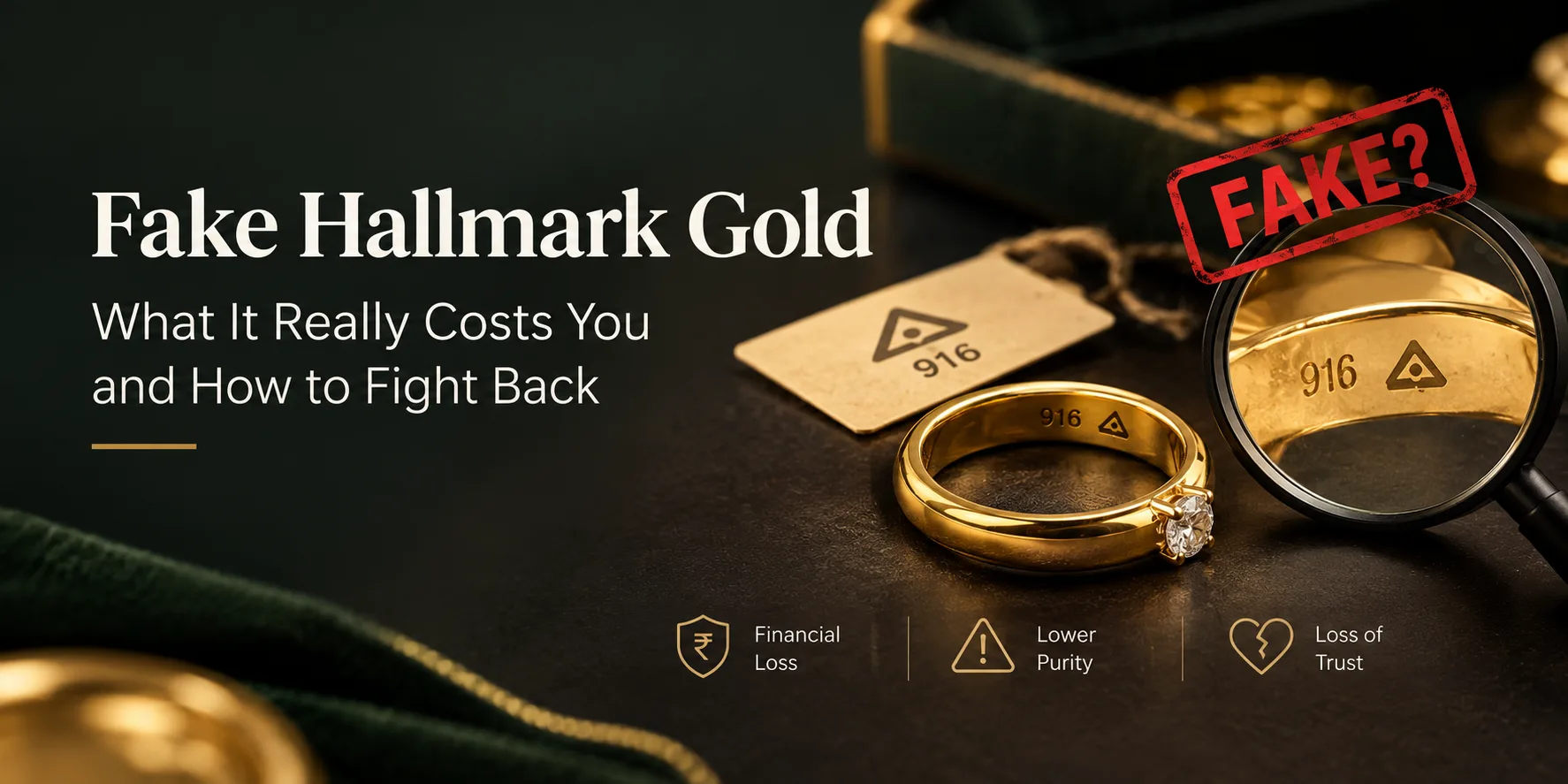





A genuine hallmark costs a jeweller ₹75 per article, after the fee revision in September 2026. A counterfeit one costs almost nothing, and the buyer pays the difference.
Read: BIS raises gold hallmarking fee to ₹75 from ₹45
In August 2026, BIS officials in Kadapa, Andhra Pradesh, seized a laser marking machine and a pen drive full of fake BIS marks from an unrecognised centre. In October, at a BIS-registered shop in Amritsar, they seized 95 articles that carried a BIS logo or purity stamp but no HUID. Read the detailed article: BIS raids hallmarking centre.
Neither was a pavement seller. That is the uncomfortable part for a careful buyer: a shop board and a stamp that looks right are no longer enough on their own.
This guide covers what a fake or missing hallmark costs in rupees, how the law treats each situation, the warning signs that go beyond "check the stamp", and the order in which to complain if you have already been sold a bad piece.
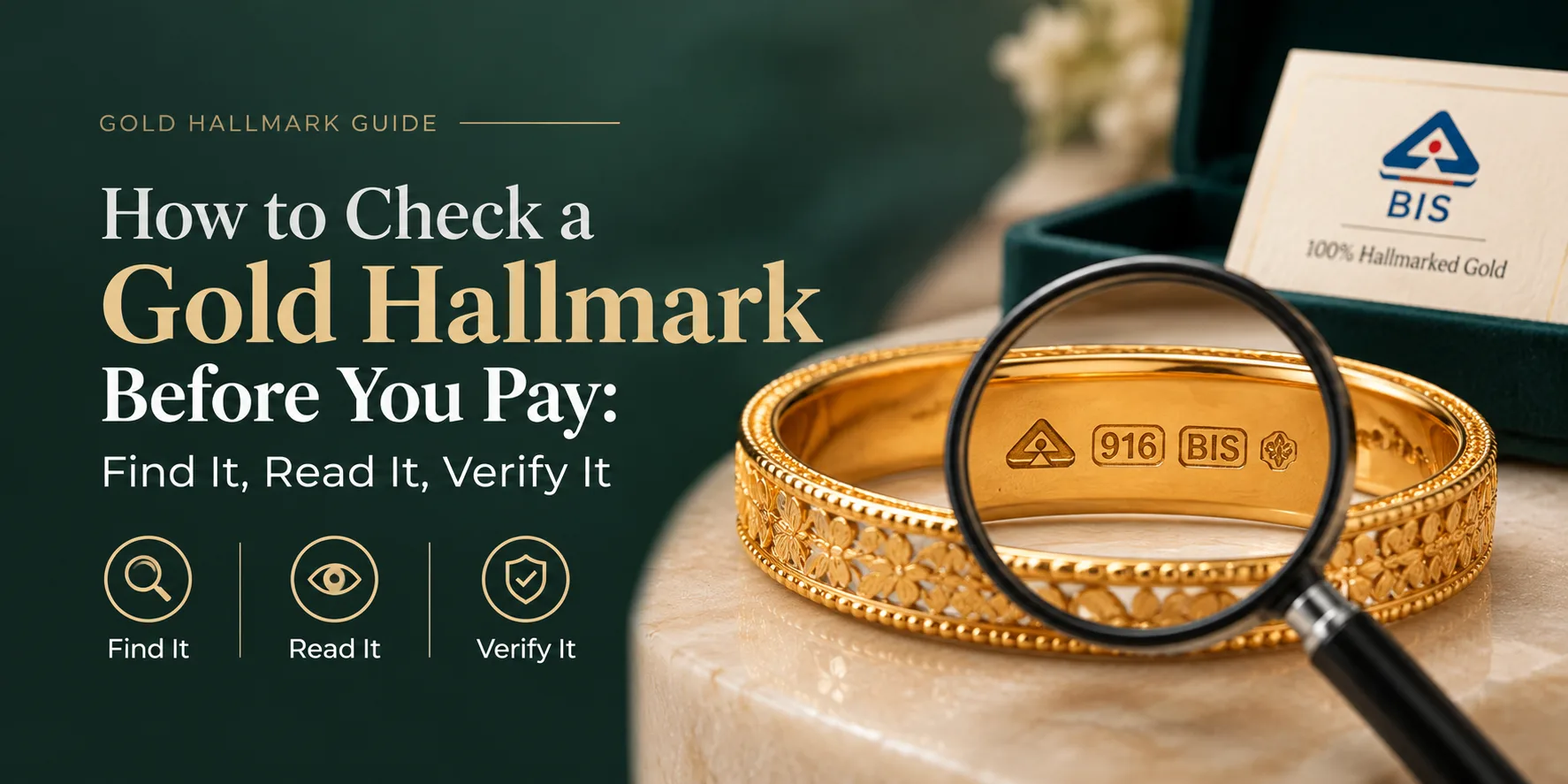
For the mechanics of reading the marks themselves, our guide on how to check a gold hallmark before you pay is the companion read. Here we assume you want to avoid a problem, or you have just found one.
No Hallmark and Fake Hallmark Are Different Problems
A piece with no hallmark and a piece with a counterfeit hallmark fail in different ways, and the law treats them differently.
No hallmark means the seller skipped the test. In a district where hallmarking is mandatory, selling a covered grade without the mark breaches Sections 14 and 15 of the BIS Act, 2016. Section 29(2) punishes it with up to one year in prison, or a fine of at least ₹1 lakh that can reach five times the value of the goods, or both.
Fake hallmark means someone imitated the proof of testing. That is misuse of the Standard Mark under Section 17, punished by Section 29(3) with up to two years in prison, or a fine of at least ₹2 lakh for a first offence and ₹5 lakh for repeat offences, extendable to ten times the value of the goods. The offence is cognizable, so the police can register a case without waiting for a court's permission.
For you as a buyer, the fake is the more dangerous of the two. With no hallmark, you know you hold an unverified piece and can price it that way. With a fake, you believe you hold a verified one, and you pay accordingly.
When No Hallmark on Gold Is Still Legal
Mandatory hallmarking works district by district. The sixth phase, effective 2 March 2026, brought the count to 380 districts, covering 14, 18, 20, 22, 23 and 24 karat jewellery and artefacts. The district list keeps changing, so check the latest hallmarking news or the BIS notification for your district before assuming either way.
Outside those districts, hallmarking is still voluntary, so a shop can lawfully sell gold with no stamp. Small articles up to 2 grams and certain notified categories are also exempt, so confirm the current order if a piece falls in a grey area.
That is exactly why no hallmark on gold is risky even when it is legal. Three things follow:
Your purity figure is whatever the next test says, and you will usually learn it when you sell, exchange, or pledge the piece.
The BIS purity-shortfall compensation rule is built around hallmarked articles. For an unmarked piece, your remedy is consumer law and the bill, nothing more.
No HUID means no record tying the piece to a registered jeweller and a testing centre. If something is wrong, nobody can be traced except by the shop's own paperwork.
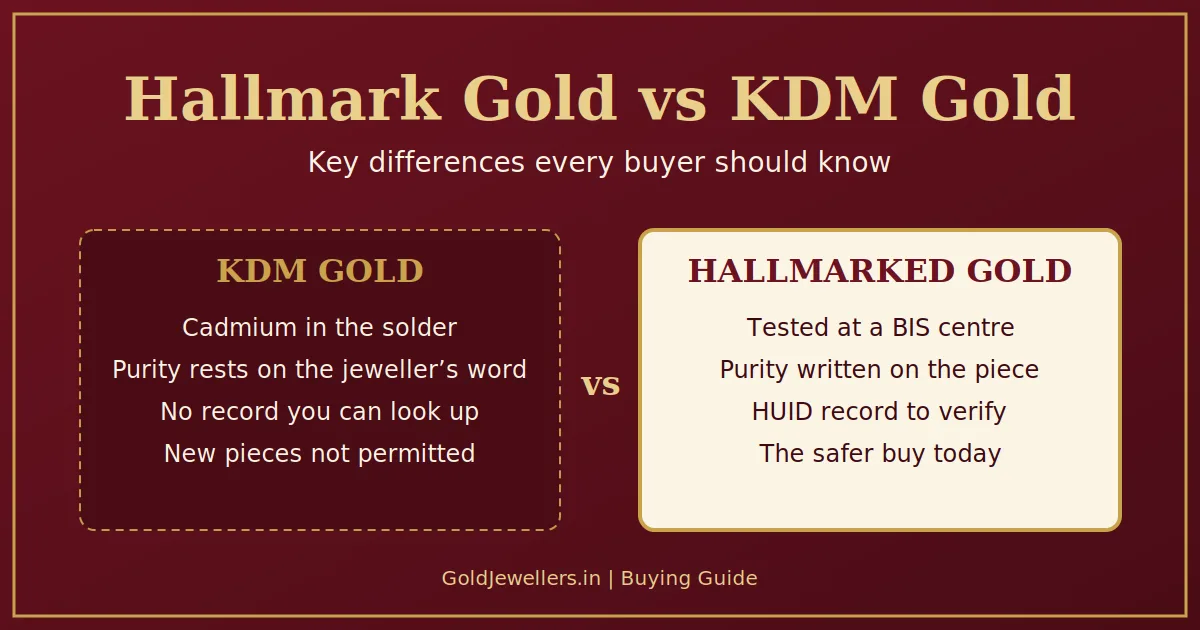
Old family gold with no stamp is a separate matter. It is legal to own and sell, as our comparison of hallmark gold and KDM gold explains.
How Fake Hallmarks Are Actually Produced
Recent BIS enforcement shows three recurring patterns.
Marks from an unrecognised centre. The Kadapa raid is one example, and a June 2026 raid in Guwahati recovered laser equipment and spurious logo material. These marks look complete because a machine applied them. What is missing is the test. No BIS-recognised laboratory assayed the gold, so the HUID either does not exist in the database or leads somewhere unexpected.
Half a hallmark. The Amritsar seizure is the pattern: a BIS logo and a purity number, with no HUID. It is the cheapest imitation to produce. Since 1 April 2023, a covered piece without a HUID should not be on sale in a notified district; however, the other marks look complete.
A real code on the wrong piece. A genuine HUID can be copied onto a different, lower-purity article. The stamp passes a glance and may even pass a lookup, because the record behind it is real. The giveaway is the record itself, which will describe an article or purity that does not match what is in your hand.
The takeaway is simple. A stamp is a claim, and the HUID record is the evidence. A hallmark you have not verified on BIS Care is a hallmark you have only looked at.
What It Costs: Putting Rupees on the Risk
Take an illustration. Assume 24K gold at ₹16,000 per gram, a making charge of 10 percent and GST of 3 percent. These are working numbers, not today's rate. A buyer picks a 30 gram chain billed as 22K (916), but the metal is actually 18K (750). If the codes are unfamiliar, our guide to what 916, 750 and other purity numbers mean lays them out.
Billed as 22K | Actually 18K | Overpaid | |
|---|---|---|---|
Metal (30 g) | ₹4,39,680 | ₹3,60,000 | ₹79,680 |
Making charge (10%) | ₹43,968 | ₹36,000 | ₹7,968 |
GST (3%) | ₹14,509 | ₹11,880 | ₹2,629 |
Total | ₹4,98,157 | ₹4,07,880 | ₹90,277 |
The buyer pays about 22 percent more than the piece is worth, and the loss is buried in three lines of the bill. Making charges and GST both scale up with the inflated metal value, which is why the damage is larger than the purity gap alone.
The loss stays invisible until you sell, exchange or pledge the piece. At that point you are paid on the purity the test finds, not the purity on the tag, and buyers who doubt a label also quote lower to protect themselves. Compare that with a ₹75 hallmarking fee. The seller who skips or fakes the stamp is saving pocket change against a ₹90,000 gain.
Your Legal Position as a Buyer
Owning a piece with a fake or missing hallmark is not an offence on your part. BIS has confirmed that consumers can sell old hallmarked or unhallmarked jewellery to a jeweller. The exposure is practical rather than criminal, and it comes in three forms.
Evidence. Everything you can do later depends on proving who sold what. A bill naming the shop, the weight, the purity, and the HUID is your claim form. Without it, you carry the burden of proof.
Cash and no-bill deals. A shop that offers a "cheaper" price for cash with no invoice is hiding more than the tax. Income tax law restricts a seller from receiving ₹2 lakh or more in cash in a day, and the penalty falls on the receiver, but the unbilled gold you carry home has no paper trail at all.
Time. Consumer commissions generally expect a complaint within two years of the cause of action. A defect found at resale five years later is much harder to pursue, which is why testing a high-value piece when you buy it matters more than testing it when you sell it.
Red Flags Beyond "Check the Stamp"
The checks for stamp depth, spacing, and logo shape already sit in our hallmark checking guide. These warning signs sit in the deal, not the metal.
The rate is better than the market allows. Compare the quoted per-gram price with the day's rate for the purity on the tag, using the live gold rates page. A price several percent under that rate is not a bargain, because the gap is usually the purity. If the arithmetic behind a quote is unclear, how gold rates are calculated shows each component.
The bill is silent where it should be specific. An invoice that says "gold ornament" with a lump sum, and no purity, net weight, or HUID, is incomplete. A "hallmark certificate" printed on the shop's own letterhead is not a BIS document.
No registration on display. Registered jewellers are expected to display the BIS certificate of registration. Ask to see it, and match the registration against the jeweller details the BIS Care record returns.
"We mark it here." Marks are valid only when a BIS-recognised Assaying and Hallmarking Centre applies them. A laser machine in the back room is the Kadapa pattern. Ask for the centre's name and recognition details, then compare them with the record.
Pressure to pay today. A discount that exists only if you pay cash, skip the bill, or decide before you leave is a pricing trick, not a favour.
Resistance to independent testing. For a large purchase, ask the jeweller to write "subject to purity verification at a BIS-recognised centre" on the bill. A seller who objects is protecting something.
Your Recourse, in the Order That Works
Five-step recourse ladder for a bad gold purchase
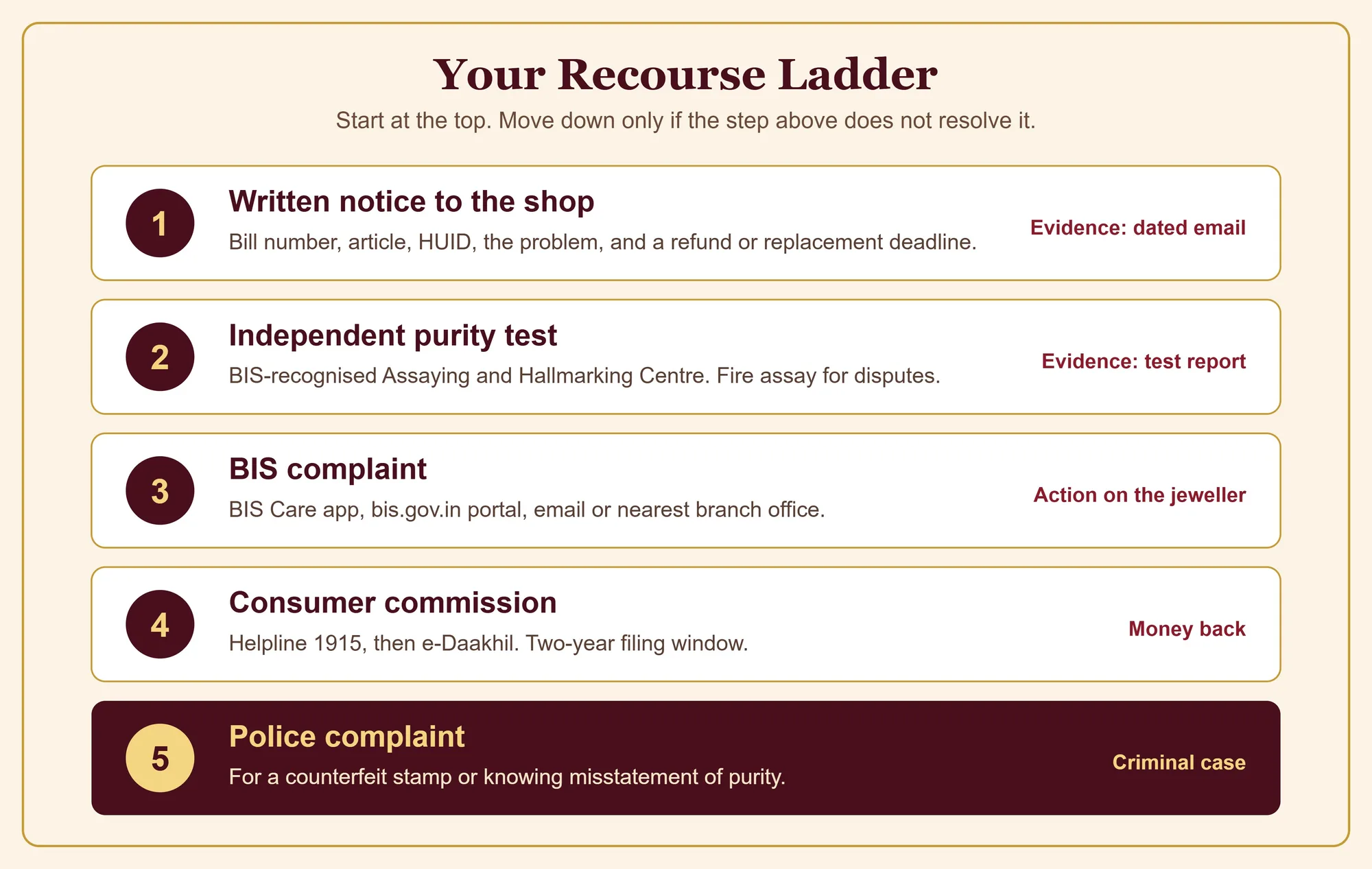
1. Write to the shop first. Send an email or letter quoting the bill number, the article, the HUID, and what is wrong. Ask for a replacement or refund by a specific date, say seven days. Keep dated proof of every message. Many genuine tagging errors end here.
2. Get an independent test. Take the piece to a BIS-recognised Assaying and Hallmarking Centre. The test is chargeable, and the written report turns "I think it is short" into a number. For disputes, fire assay is generally treated as the referee method, because XRF reads only a thin surface layer and a plated or surface-enriched piece can read higher than its body.
3. Complain to BIS. BIS accepts complaints on misuse of the Standard Mark and on the hallmarking scheme through:
the BIS Care app
the Consumer Engagement Portal on bis.gov.in
email at complaints@bis.gov.in
a letter to the Public Grievance Officer at the nearest BIS branch office, or to the Head of the Complaints Management and Enforcement Department
Attach the bill, close-up photos of the stamp, a screenshot of the HUID lookup, the test report, the shop's address, and your dates. BIS investigates, can search and seize stock, can cancel a jeweller's registration and can prosecute under Section 29. BIS officials have said that complainants' identities are kept confidential.
On compensation, BIS Rules 2018 provide that when a hallmarked article is below its marked purity, the buyer is owed twice the value of the shortfall plus the testing charges. In the chain example above, a shortfall of ₹79,680 would work out to ₹1,59,360 plus testing charges, though the actual figure is settled through the BIS process. That rule covers genuinely hallmarked pieces that test short. For a counterfeit stamp, go to steps 4 and 5.
4. Approach the consumer commission. The National Consumer Helpline (1915) can take up your grievance before you litigate, and cases are filed online through e-Daakhil. A district commission handles claims up to ₹50 lakh. A legal notice before filing often prompts a settlement. Ask for a refund of the overpayment, the testing charges and compensation.
5. File a police complaint if the mark itself is counterfeit. Where you can show a forged stamp or a knowing misstatement of purity, an FIR for cheating under Section 318 of the Bharatiya Nyaya Sanhita is reasonable. Section 29(3) of the BIS Act is cognizable, which supports a police case.
Two things to avoid: do not melt, resize, or alter the piece before testing, and do not sign a store credit note or settlement that waives your rights until you hold the test report.
Buy So You Never Need Any of This
Prevention costs a few minutes. Browse jewellers you can trace, ask for the HUID on every line of the invoice, and verify each code on BIS Care before you pay. For a big purchase, make the sale conditional on a lab test. If you are shopping in a wholesale market, read our map of the famous gold markets of India first, and buy bridal sets from stores in the bridal jewellery category that handle ten and fifteen piece invoices every week. Not sure whether 22K is the right grade for you? Our guide to 22K vs 24K gold will settle it.
You can also start from shops that are already vetted. Use the trusted jewellers filter or browse by city, then compare before you walk in.